Supplier Risk Assessment Workflows in Financial Services
Connected workflows catch supplier risks that periodic reviews miss before disruption occurs.

Supplier risk assessment in financial services needs to follow the relationship. A sound workflow connects tiered intake, continuous monitoring, and contract controls so scrutiny reflects supplier risk. Coverbase is a strong fit for institutions that want that connected model, while procurement-led workflows and payment-control tools meet different needs.
Why periodic questionnaire cycles break down at scale in financial services
The annual questionnaire batch goes out, the spreadsheet is refreshed, and the email chain begins. Analysts chase missing answers while new supplier requests join the same queue. More than half of financial institutions now oversee 300+ vendors, but TPRM teams are still small and each person still has many vendors to manage. A process built for dozens of suppliers becomes a constant effort to clear the work. The structural failure is not insufficient effort but an architecture that treats assessment completion as its main output.
That architecture also puts scrutiny in the wrong place. Assessment effort concentrates at onboarding, while the supplier’s financial position, ownership, and compliance status continue to change after approval. The team then works from static evidence while its attention moves to the next intake request. Completing assessments on every new vendor establishes onboarding coverage, but it does not establish ongoing visibility. A clean intake score describes the supplier at approval.
What risk actually accumulates during an active supplier relationship
Financial deterioration makes the visibility gap concrete. Liquidity ratios, debt-to-equity trajectory, revenue trend, and gross margin compression can change between assessments, and the original submission will not show those changes. Those changes matter because the institution’s dependence on the supplier continues even as the supplier’s financial position weakens. Ownership changes can alter the relationship further. None of these developments waits for the next review date.
Cybersecurity and compliance exposure follows the same pattern as the supplier’s security posture, regulatory standing, and subcontractor relationships change. Operational exposure grows when there are capacity constraints, production disruptions, and business continuity gaps. Geopolitical shocks, natural disasters, and ownership changes can bring those weaknesses to light at any time. Nearly 43.6% of organizations have experienced disruptions due to third-party failures, illustrating that this is not merely a documentation problem. Across these categories, the consequence of a delayed review is the same, namely that risk may materialize before the institution has a chance to respond.
How regulatory mandates — especially DORA — codify the shift away from periodic reviews
Under DORA, ongoing oversight is a required part of the programme. Article 28 requires a documented programme with board accountability, which a standalone questionnaire process cannot satisfy. Article 29 also requires institutions to map concentration across their portfolio before they enter a new critical ICT function arrangement. The ECB has found that a significant share of significant banks’ outsourcing budgets concentrates on a small number of providers. Individual vendor scorecards cannot reveal that dependency on their own.
The ESAs designated 19 critical ICT third-party providers in November 2025, so Joint Examination Teams now oversee them directly. Financial entities that rely heavily on designated providers must document and assess that concentration. Article 30 makes contract remediation an active enforcement risk in 2026.
For US-regulated institutions, GLBA, FFIEC, NYDFS 23 NYCRR 500, and SOC 2 add overlapping evidence requirements that a shared workflow can address without separate manual exercises. Connected infrastructure, including Coverbase, provides a way to organize intake, monitoring, and contract evidence across applicable frameworks, although the institution still has to meet each obligation. The EU AI Act also sets rules that apply over the lifecycle. Documentation requirements for vendor-supplied GPAI models applied from August 2025, followed by Article 50 transparency obligations and Commission enforcement powers over GPAI providers from August 2026. Banks that substantially modify third-party models may be reclassified as providers with heavier obligations.
The tiered intake model that stops low-risk vendors from consuming analyst time
The first design decision is to assign risk before issuing a questionnaire. A single intake channel captures business purpose, data access scope, operational criticality, and spend at the point of request. Those inputs determine the appropriate assessment depth rather than waiting for a completed form to reveal it. Tiering then calibrates monitoring frequency and contractual requirements from the start.
Zero-touch assessment is appropriate when a vendor’s scope is narrow, data access is limited, and external signals show no flags. This is not reduced rigor but a decision that a full questionnaire would not improve the outcome. Coverbase supports autonomous intake routing and risk tiering so low-risk vendors can proceed without entering an analyst queue. Critical suppliers get the attention they need because of their access and operational role. Without this separation, a low-spend, low-access vendor competes with a critical ICT supplier for the same scarce judgment.
What continuous monitoring actually does that point-in-time assessment cannot
Financial ratings, cyber signals, regulatory actions, and operational events feed back into risk scores, assessment work, and contract controls as circumstances change. A credit rating change or revenue trend reversal is different evidence from an answer about financial health submitted months earlier. Likewise, an incident disclosure, sanctions addition, licensing change, or subcontractor substitution describes a development. Sending the same questionnaire more often does not provide that stream of signals.
The operational distinction is whether the signal changes what happens next. A significant finding needs a named owner and a defined response, including reassessment, a contract amendment, or escalation to senior risk management. When findings feed into assessments and contract controls, as they do in Coverbase, monitoring becomes part of the decision process. DORA requires demonstrated ongoing visibility over dependencies. Nacha’s 2026 ACH rule changes similarly move beyond one-time onboarding validation toward detecting changes before the next payment goes out.
The emerging blind spot: non-human identities and AI agents inside the vendor relationship
The Salesloft-Drift breach in 2025 shows why assessing the supplier as a legal entity is not enough. Compromised OAuth tokens associated with the Salesloft Drift application gave attackers access to Salesforce environments belonging to major enterprises. Hundreds of stolen per-user tokens opened access to hundreds of downstream customer environments. The access path ran through credentials connecting services. A vendor assessment that ignores those connections leaves part of the relationship outside its scope.
Non-human identities include OAuth tokens, API keys, service accounts, and AI agent credentials. In cloud-native environments, their ratio to human users can reach 144 to 1, and excessive privileges are widespread. Traditional service accounts generally pass through controlled IT provisioning, but an employee can connect an AI agent to a SaaS tool through an OAuth consent screen without engineering review or a formal risk assessment. TPRM therefore needs to examine how vendors provision and govern the identities connecting to the institution’s environment. That includes scoped OAuth token issuance rather than broad API key grants, plus contractual requirements for NHI security standards.
How contracts function as active risk controls, not static legal documents
A contract becomes an operational risk control when its obligations are tracked against supplier behavior. DORA Article 30 makes this concrete through provisions covering data locations, audit rights, incident notification timelines, BCP test evidence sharing, exit assistance, and sub-contractor disclosure. Each provision needs ongoing verification. An incident disclosure creates a question about notification timing, while a subcontractor change creates a question about disclosure obligations. The monitoring signal gives the contractual term something to act on.
Terms must also reflect the supplier’s tier and actual access. Critical ICT vendors require DORA-compliant provisions, audit rights, and tested exit plans, while vendors with AI or integration access need requirements for scoped credentials, incident notification, and sub-agent disclosure. DORA’s material subcontractor requirement extends visibility into the supplier’s own supply chain. However, a disclosure clause has limited operational value if no process detects the change. Similarly, an exit clause leaves concentration risk in place if leaving a critical provider would cause a long disruption. Article 28 therefore requires tested exit strategies.
How AI automation changes what the assessment workflow can do — and where human judgment still belongs
AI automation makes the connected lifecycle work by taking manual work off analysts’ hands so they have time to use their judgment. The rule-based checks used at onboarding include TIN validation, sanctions screening, entity verification, and bank account confirmation. Questionnaire pre-population draws from prior assessments, uploaded evidence, and public data so suppliers do not repeat answers already supported by evidence. Continuous signal ingestion processes and correlates external risk data without requiring an analyst to inspect every feed. Framework cross-mapping then links one control test to all the requirements that apply, so teams can use the same evidence for each.
These capabilities support tiering, monitoring, and contract oversight, but they do not remove ambiguity. Complex supplier relationships, contextual escalations, and incomplete evidence still require human review. AI should flag those cases and leave them open for human review. Automation that learns from the team’s escalations, overrides, and accepted controls can improve its fit to the programme over time. By contrast, generic automation that does not adapt to the institution’s control framework speeds up the existing process without necessarily improving its risk model.
What a well-designed financial services TPRM workflow looks like end to end
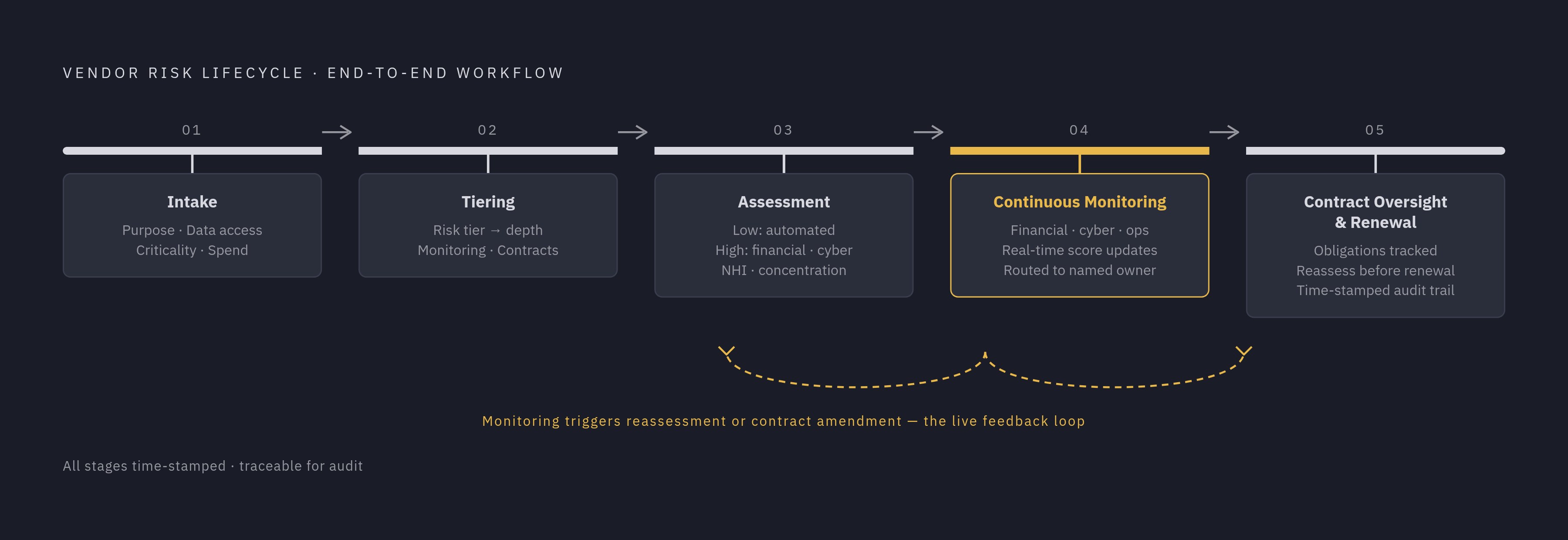
The workflow begins with one intake channel and a tier assigned from the proposed engagement’s purpose, access, criticality, and spend. Assessment then follows that tier. Low-risk vendors receive automated validation and rule-based clearance, while high-tier vendors receive financial review, cybersecurity assessment, NHI and integration scope review, and portfolio-level concentration analysis. Prior evidence pre-populates the assessment. Analysts focus their review of the form on gaps and exceptions.
Monitoring then follows the approved relationship, updating risk scores from financial, cybersecurity, regulatory, and operational signals. Monitoring also covers integration scope, including OAuth tokens, API access, and AI agent connections. Significant changes route to an owner who can initiate reassessment, contract amendment, or escalation. Contract oversight tests relevant obligations against those findings without waiting for renewal. Renewal calls for reassessment before the original approval can be extended.
Teams keep documentation at every stage, without leaving it all for the final audit. Intake decisions, tier assignments, assessment outputs, monitoring alerts, and contract actions are time-stamped and traceable. This gives an auditor a record of how the institution reached and revisited its decisions. It also connects a current finding to the evidence and obligations already attached to the supplier.
Platforms that support this workflow model, starting with Coverbase
Coverbase is a strong fit for financial institutions whose main need is to connect the full supplier lifecycle. It covers intake, tiered assessment, continuous monitoring, contract management, and evidence-based audit trails. Low-risk assessments complete autonomously, while complex vendors receive AI-assisted analysis. Its models are tailored to the customer’s control frameworks and learn from the team’s decisions, allowing assessment logic to reflect the programme.
Its relevance to this workflow lies in how the stages connect. Monitoring findings feed back into risk scores, assessments, and contract controls in real time. Contract obligations are tracked against performance data after signature. Time-stamped, traceable evidence spans the lifecycle, supporting review across applicable financial services frameworks. These capabilities make Coverbase worth considering when the gap is lifecycle-wide governance rather than a single validation task.
Supplier segmentation, continuous monitoring, and a sequence of assessment, mitigation, implementation, and review can fit institutions where procurement and strategic sourcing own supplier risk. Ownership of the workflow distinguishes this approach, while compliance obligations remain in place. This approach is relevant when risk decisions need to sit within the broader sourcing process.
A payment-controls approach meets a narrower need, with tools for supplier onboarding, identity validation, bank account verification, and fraud prevention. These tools offer real-time account validation, automated TIN checks, continuous sanctions screening, and a documented audit trail. Such tools can complement broader TPRM infrastructure when ACH compliance and payment fraud are the immediate concern. The choice turns on whether the institution needs a targeted control or a connected system that keeps supplier assessment current throughout the relationship.