Vendor Risk Appetite Statements That Reflect Real Thresholds
Making vendor risk appetite statements actually guide decisions instead of sitting unread in files.

Most vendor risk programs already have an appetite statement, but the document rarely touches the moment someone decides whether to onboard a vendor, assign it to a tier, escalate a finding, or walk away from the relationship. A risk appetite statement is formally defined as the amount of risk an organization is willing to accept in order to meet its strategic objectives, based on quantitative and qualitative measurements, and the threshold it describes is the line the organization has decided not to cross. In practice, the statement sits in a file, gets reviewed once a year, and gets consulted by no one making a live decision about a vendor on a given Tuesday.
The gap is not a matter of intent. The gap is structural: turning a general appetite statement into something that actually governs decisions requires a consistent methodology, a tier assigned to every vendor in the portfolio, and clear ownership split among procurement, security, legal, and the business unit that wants the vendor onboarded. That is real work, and it is exactly the kind of work that gets pushed down the list when the same team is buried in assessment backlogs and running short-staffed.
Governance literature draws a line that most programs blur. A Risk Appetite Statement sets the outer boundary of what an organization will accept. Risk policies are the mechanism by which the organization stays inside that boundary. MetricStream's guidance on GRC programs treats both layers as necessary: the RAS defines where the edges are, and the policies are built to keep operations inside them. If you drop the second layer, the first one governs nothing. A boundary with no mechanism to enforce it is a line drawn in a document nobody opens before making a call.
The structural difference between appetite, tolerance, and an enforceable threshold
The words "appetite" and "tolerance" get used as if they mean the same thing, and that confusion is a large part of why so many frameworks never become enforceable. The space between the two numbers is the zone of acceptable overage, the range where a vendor can sit above the ideal but below the point of no return.
That zone has a direct operational consequence. A threshold is the specific, measurable trigger attached to a key risk indicator that tells a team, at any given moment, which of the three zones a vendor occupies: inside appetite, inside tolerance, or in breach.
If you strip out this three-level architecture, a vendor risk program loses its escalation logic. Every decision becomes a fresh judgment call, and the appetite statement ends up as an aspiration, not a working control. The KRI layer and the risk limit layer are where an abstract appetite number turns into a threshold someone can act on. Everything before that layer is description. Everything at that layer and after is enforcement.
What real vendor risk thresholds look like in practice
A threshold only counts as real once it specifies three things at once: a measurable condition, the KRI that tracks that condition, and the action the KRI's breach sets in motion. The KRI attached to that limit tracks vendor concentration against the cap, but it also watches for repeated SLA breaches, because a vendor that keeps missing its service commitments behaves like a concentration risk even before the percentage math says so. The action trigger specifies what happens next: start diversifying the vendor base, renegotiate contract terms, or activate the exit plan that should already exist for that relationship.
Venminder's framework for third-party risk appetite names the pieces that need to exist for that kind of translation to happen consistently: governance and oversight, standardized risk definitions, standardized appetite levels running from risk-seeking to risk-averse, risk appetite thresholds and risk metrics kept as two distinct components rather than merged into one, training so staff actually understand the categories, risk reporting, and authorization guidelines spelling out who can accept risk at which level. That last piece deserves attention on its own. A threshold without a matching authorization tier is advisory at best: the number exists, but nobody has been told whether they're allowed to act on it alone.
The SCORE model, covering strategic, compliance, operational, reputational, and expense risk, gives programs a way to write separate appetite statements for each of these categories instead of forcing every vendor risk through a single undifferentiated number. Guidance from the Financial Stability Board, cited in MetricStream's material as the recognized standard for board-level risk appetite governance, names four elements an effective framework needs: the risk appetite framework itself, the risk appetite statement, a set of risk limits, and a clear statement of roles and responsibilities for the board and senior management. That structure came out of financial services, but contract value, data sensitivity, and vendor concentration are not specific to a regulated bank. Any organization that manages vendor risk can benefit from building toward the same four pieces.
How vendor tiering connects appetite thresholds to scrutiny
Tiering gets treated, too often, as a sorting exercise that happens before the real risk management starts. That framing has it backward. Tiering is the mechanism that puts an appetite threshold into motion the moment a vendor enters the program. Tiering is the decision gate that routes each vendor to the depth of scrutiny its risk profile actually warrants.
The link to appetite is direct rather than incidental: each tier should carry its own threshold set, inherited from the enterprise appetite statement but scaled to the stakes involved. A Tier 3 vendor, selling a commodity service with plenty of substitutes in the market, can run under a lighter threshold set with fewer KRIs attached, because the cost of over-monitoring a low-stakes vendor is wasted effort that could go toward the vendors that actually carry concentration or compliance risk.
Tiering doesn't stop at onboarding. It also sets the rhythm and depth of ongoing assessment, which is how an appetite statement ends up governing monitoring over the life of the relationship rather than just the initial decision to bring a vendor on board. A compliance-sensitive vendor in a regulated category and a low-stakes commodity vendor should never be governed by the same number.
Substitutability is the dimension most tiering models underuse. A vendor that can be swapped out in a matter of weeks carries a different tolerance ceiling than one whose exit would take well over a year to execute cleanly. If you build substitutability into the tiering score directly, instead of treating it as a side note during exit planning, you tie concentration risk appetite to tier assignment the moment a vendor enters the program, not months later when a renewal or an incident forces the question.
KRI design: attaching measurable signals to each threshold
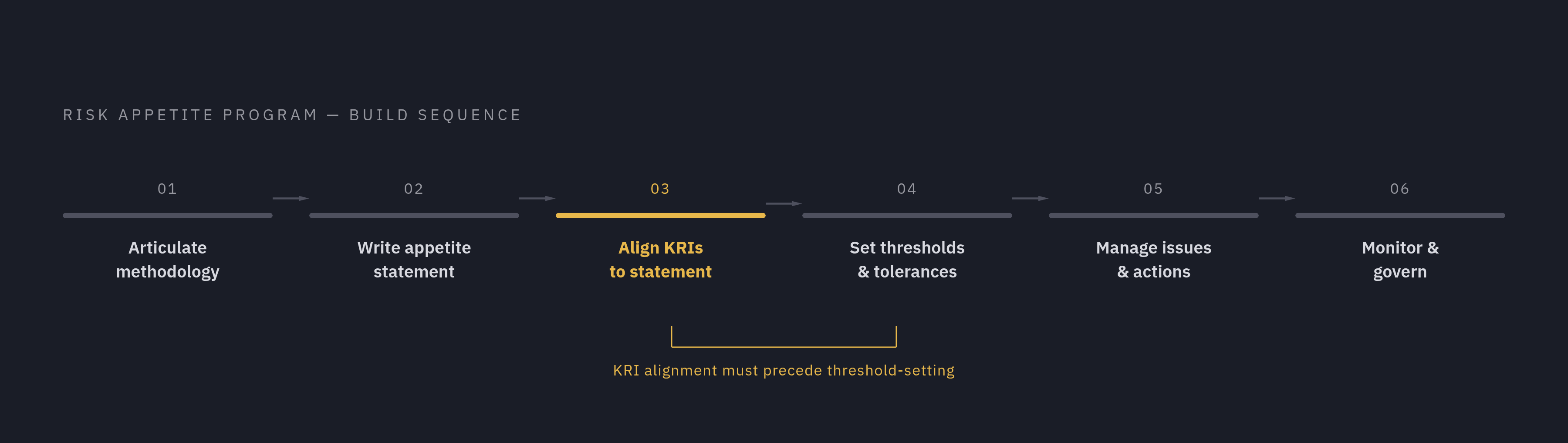
A threshold with no KRI attached is just a sentence in a policy document. A KRI with no threshold attached is a number on a dashboard that nobody has told what to do with. Each one fails on its own, and the pair only works when they're built together. Effective KRI design for vendor risk needs to cover, at minimum, security posture signals such as open critical vulnerabilities and overdue patching, financial health indicators for the vendor itself, how often SLAs get breached, how concentrated the organization's dependence on that vendor has become, and whether a sub-contractor or fourth party has changed without notice.
The sequence matters here as much as the content. The widely used six-step cycle for building a risk appetite program runs: articulate the methodology, write the appetite statement, align KRIs to that statement, set thresholds and tolerances, manage issues and actions as they arise, and monitor through governance and dashboards. KRI alignment comes before threshold-setting in that sequence, not alongside it. Teams that skip the alignment step and jump straight to picking numbers end up with thresholds they have no way to actually monitor, because the metric that would trigger the threshold was never built or never connected to a live data feed.
The timing of a KRI's trigger point carries more weight than most programs give it. A KRI should fire while a vendor is still inside the zone between appetite and tolerance, not after it has already crossed into breach. That gap between the two numbers is an early-warning corridor, and a KRI calibrated to activate the moment a vendor enters that corridor buys the team time to act before escalation becomes mandatory. A KRI that only fires at the tolerance ceiling has already run out the clock on the one period when a renegotiation or a mitigation plan could have prevented a forced decision later.
The non-human identity gap that most appetite frameworks don't cover
Appetite frameworks were built around the assumption that a vendor relationship is something the organization enters into deliberately, with a contract, a procurement process, and a named counterparty. That assumption no longer covers how vendor risk actually enters enterprise systems. Traditional vendor onboarding governs the organization as a counterparty to a contract. It says nothing about the OAuth tokens, API keys, and service accounts that the vendor's software quietly provisions once it's connected, and those identities sit entirely outside the appetite framework as most programs have built it.
Today, connecting an AI agent or a SaaS plugin to enterprise systems can take nothing more than an employee clicking through an OAuth consent screen. Vendor-provisioned non-human identities are created outside the entire third-party risk management lifecycle, appearing in the environment before anyone on the risk team has even assigned the originating vendor a tier, let alone a threshold.
The fix has to sit inside the same threshold logic the rest of this piece has described, not bolted on as a separate security control. Any third-party agent, integration, or AI tool that connects to enterprise systems should be governed under the same threshold architecture as the vendor providing it: scoped token issuance, contractual security requirements written into the vendor agreement, and continuous monitoring for anomalous access patterns all belong inside the appetite framework as enforceable controls, not as optional extras layered on by a security team working around the TPRM process. SaaS plugins and autonomous AI agents need to be treated as vendors in their own right, each with its own tier assignment, its own KRI set, and its own threshold triggers. An appetite framework that has no explicit category for non-human identity has a hole in it large enough for an entire class of vendor risk to pass through unmeasured.
DORA and related frameworks forcing threshold specificity
For financial services firms, the shift from a general appetite statement to an enforceable threshold stopped being a maturity goal and became a legal requirement once the Digital Operational Resilience Act took effect. DORA has been fully applicable since 17 January 2025, and it mandates continuous oversight of vendors, risk management that scales with the vendor's criticality, specific contract clauses for critical vendors, controls on concentration risk, mapping of sub-outsourcing arrangements, and tracking of fourth-party vendors sitting behind the primary relationship. None of these requirements can be satisfied with a prose statement about risk appetite. Each one is a threshold category that has to be built, measured, and monitored, with a mechanism behind it that can show a regulator the control is actually operating, proving to oversight that the control is live.
Concentration risk, in particular, moved from a program-level concern to a formally enumerated regulatory one in November 2025, when the European Supervisory Authorities, the EBA, EIOPA, and ESMA, published the list of designated Critical ICT Third-Party Providers under DORA. That list gives regulated firms a named set of providers whose concentration risk now carries direct oversight attention, the clearest sign yet that "low appetite for vendor concentration" has to translate into a specific, monitored number.
Firms outside the scope of DORA aren't without comparable guidance. The direction these frameworks point in is consistent: appetite has to show up as a specific, measured threshold that a program can demonstrate is working.
Continuous monitoring as a different mechanism, not a better audit
An audit answers a question about a single point in time: was the vendor compliant on the day the assessment was run. A threshold built around continuous monitoring answers a different question entirely: is the vendor inside appetite, inside tolerance, or in breach right now, and has that status changed since the last time anyone looked. These are not the same mechanism running at different speeds. An annual or quarterly audit cycle cannot catch a vendor's slide from appetite into the tolerance corridor in real time, because the entire design of an audit assumes the gap between reviews is acceptable risk exposure. A KRI tied to a threshold, reporting continuously, closes that gap by design.
The threshold defines the condition. The tier decides which thresholds apply and how closely you watch the vendor. The KRI is the instrument that reports the vendor's position against the threshold on an ongoing basis. Non-human identities and AI agents need their own thresholds and KRIs that feed into the same monitoring stream, not a separate shadow process. Regulatory frameworks like DORA have made this continuous model a requirement, not just a best practice, for firms inside their scope, and NIST's guidance extends the same expectation to organizations that fall outside financial services regulation.
None of this replaces the appetite statement a board already approved. It gives that statement something to stand on: a tier for every vendor, a KRI for every tier, a threshold for every KRI, and a monitoring mechanism that reports where each vendor sits against that threshold without waiting for the next scheduled review to find out.