Feeding Monitoring Findings Back Into Vendor Risk Scores
Stale vendor risk scores hide threats that emerge between annual reviews.
A vendor risk score is supposed to tell you something true about right now. One that doesn't move when new evidence comes in stops measuring present risk and starts recording whatever was true on the day someone last looked. Call it what it is: a timestamp with a number attached, and treating it as anything more is the mistake sitting at the center of most third-party risk programs.
Consider what the score actually claims. It says: based on what we know, this vendor carries this much risk, right now. The moment new evidence contradicts that claim, the score stays put, and the claim quietly turns false. Nobody updates the paperwork to say so, because nobody's watching for the moment it happened.
The stakes aren't abstract. Third-party and supply chain attacks took an average of 267 days to detect and contain in 2025, the longest window of any threat vector tracked. A score recalculated once a year can sit wrong for most of that stretch, and nobody would catch it, because the one artifact built to flag the problem never changed.
Continuous monitoring is still the exception, not the norm. Bitsight's State of Cyber Risk and Exposure report found that only 1 in 3 organizations continuously monitor all their third-party relationships for cyber risk. The rest run on assessment cycles with gaps measured in months, sometimes a full year. In that gap, a vendor can get breached, lose a certification, get hit with an enforcement action, or change ownership entirely, and the score sitting in the risk register won't reflect any of it until the next scheduled review. At that point, calling it a control is generous. It's a filing cabinet that updates once a year.
Vendor risk score measurements and scoring model limits
A vendor risk score, when stripped down, is usually built from four categories: cybersecurity posture, operational stability, regulatory compliance, and financial health. Each maps to a different kind of failure a vendor can hand you, from a breach to a missed SLA to a lapsed license to a balance sheet that can't survive its next quarter.
Two architectures tend to show up. Likelihood-times-impact models multiply the probability of a bad event by its consequence, producing something concrete enough to defend in an audit conversation. Weighted scoring models instead assign policy-level weights to each category: a hospital system might weight data privacy and cybersecurity heaviest, while a bank shifts weight toward regulatory compliance and operational resilience. Those weights should come from deliberate policy decisions, not from whatever the vendor happened to submit on a questionnaire, and any model that lets the vendor set its own weighting has already failed before the first score gets calculated.
A model worth trusting separates inherent risk from residual risk and reports both. Inherent risk describes the vendor relationship with no controls in place. Residual risk is what's left once compensating controls, contractual protections, and monitoring get factored in. The gap between those two numbers is, in a real sense, the entire value the third-party risk program produces. Collapsing them into one blended figure erases that value from view, making it impossible to tell whether the controls are doing anything.
Most scoring models measure activity instead of risk. A dashboard logging completed questionnaires and green checkmarks isn't a control if nothing about those checkmarks changes what anyone does next. Counting "we sent the questionnaire and got it back" as risk evidence optimizes for paperwork completion, not for an accurate picture of exposure. That habit is the most common failure in the field, and it's also the one that looks the most like diligence to anyone glancing at it from outside.
The categories of monitoring findings that should trigger a score change
Not every alert deserves to move the score. Without clear rules about which signals cross that line, monitoring tools generate noise, the noise piles up in a queue somewhere, and the score sits untouched anyway. That's the same failure as no monitoring at all, just wearing a different outfit.
Cybersecurity posture signals are observable from outside, and no cooperation from the vendor is required, since an open port that wasn't open last scan, credentials surfacing in a breach dump, a host talking to known botnet infrastructure, a lapsed certificate, or DNS records shifting in a way that doesn't match the vendor's known infrastructure all count as such signals. Patching velocity is quieter but just as telling. A vendor current on patches in January who's fallen three months behind by March has a materially different security posture, even if nothing else about the relationship changed on paper. A confirmed breach or ransomware event is the clearest case of all, and it should trigger an immediate score change instead of waiting for the next scheduled cycle.
Compliance and regulatory signals produce the paperwork that establishes the whole trust relationship. A lapsed SOC 2 or ISO 27001 certification means the assurance the score was built on no longer exists, so the score has to reflect that gap right away, not at the next review. A sanctions hit or a regulatory enforcement action against the vendor changes the calculus, and so do regulatory filings that alter a vendor's compliance obligations. Frameworks like DORA require detecting and responding to material changes in third-party risk on an ongoing basis, not documenting them once a year, so compliance with those rules depends on the score actually moving when these signals show up.
Financial and operational signals round out the picture: a credit rating downgrade, public signs of financial distress, an acquisition or ownership change that alters not just who holds the contract but potentially the entire security program behind it, a pattern of outages eating into SLA performance. News signals count too, whether it's a regulatory investigation opening up or a critical vendor's top security executive walking out the door with no announced replacement.
Two update tracks: scheduled recalculation vs. event-triggered recalculation
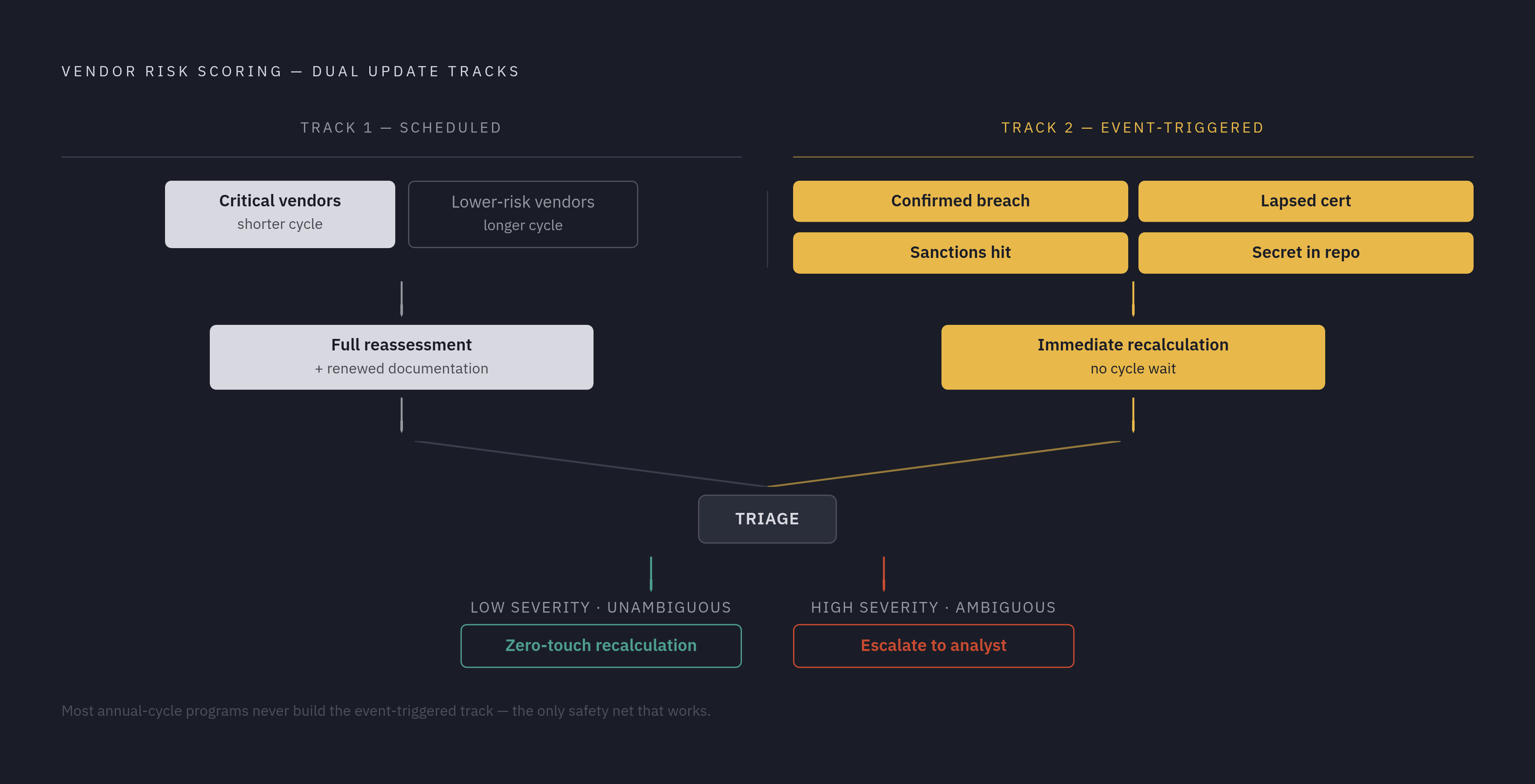
Scores need two separate rhythms, not one blended cadence. A scheduled track handles periodic full recalculation, tiered by vendor criticality: critical vendors get reassessed on a shorter cycle, lower-risk vendors on a longer one. Full reassessments and renewed documentation flow back in through this track.
The second rhythm is event-triggered, and it's the one most annual-cycle programs never build. When a finding crosses a pre-defined threshold, a confirmed breach, a lapsed certification, a sanctions hit, a critical secret exposed in a code repository, the score recalculates immediately. Waiting for the next scheduled review isn't an option for signals like these, because by the time the cycle comes around, the exposure has already run its course.
The split also determines where analyst time goes. A low-risk vendor shouldn't pull someone into a manual review every time an unambiguous, low-severity signal comes through. Systems can resolve those cases on their own, reserving zero-touch recalculation for the clear-cut findings and analyst escalation for the ones that actually require judgment.
Annual-only cycles leave a visibility gap that regulators, DORA in particular, have moved to address through continuous-monitoring obligations. The scheduled track was never meant to double as the safety net. That job belongs to the event-triggered track, and it only works if thresholds get set in policy ahead of time, not decided in the moment by whoever happens to be on call. Define the threshold, automate the recalculation, escalate for a human decision only where one's actually needed. That sequence is what turns a feedback loop into a control instead of another notification nobody reads.
Closed-loop architecture between monitoring and scoring in practice
A closed loop means findings flow from monitoring straight into the score, the score drives tiering and treatment decisions, those decisions update contracts and remediation plans, and completed remediation flows back into the score again. Evidence should never sit disconnected from the number meant to represent it. Three layers keep it from doing so.
Signal ingestion sits at the bottom. External sources feed in threat intelligence, security ratings data, credit services, breach databases, regulatory filings, news monitoring. Internal sources matter just as much: findings from non-human-identity discovery tools, SaaS integration audits, access reviews, contract monitoring workflows. Externally observable data doesn't need the vendor's cooperation to update, and it keeps updating regardless of whether the vendor answers an email. Self-reported questionnaire data alone can never close this loop, because it depends entirely on the one party with the least incentive to volunteer bad news.
Score recalculation is the middle layer. New findings get matched against pre-mapped rules that translate a finding into a score impact, using the same policy-level weights defined earlier. Event-triggered findings recalculate on the spot; scheduled ones wait for their cycle. Both inherent and residual risk update here, and not always in lockstep: a new finding might raise inherent risk while leaving residual risk untouched, if compensating controls are confirmed and holding. If those controls turn out missing or broken, both numbers move together.
Tiering and treatment response sit on top. A score change should force a recheck of the vendor's tier assignment, and a vendor that crosses a threshold might jump from standard to critical, bringing a tighter review cadence and closer contract scrutiny with it. Remediation workflows should launch automatically once a score change crosses a defined severity line, while lower-severity findings simply queue up without needing an analyst to push a button.
AI and Automation for Portfolio-Scale Feedback Loops
The scale problem here is a headcount shortfall, mostly. Organizations manage vendor portfolios that have grown into the hundreds, while risk teams haven't grown anywhere near that rate. Manually reviewing every monitoring signal and manually recalculating every score isn't something a team that size can sustain, full stop, and pretending otherwise is how backlogs form.
Automation earns its keep on the repetitive, well-defined parts of the job: ingesting continuous external signal streams with no human in the loop, matching findings against pre-mapped score impact rules and recalculating on the spot, handling zero-touch score updates for low-risk vendors and unambiguous findings so analyst hours go where judgment is actually needed. It also generates the audit trail and timestamped evidence log as a natural output of the workflow, rather than a separate documentation chore tacked on afterward.
Judgment still belongs to people, and that line shouldn't move. Interpreting a signal that doesn't map cleanly onto any existing rule, deciding whether a finding is serious enough to force contract renegotiation or a direct escalation to the vendor, setting and periodically recalibrating the policy-level weights and thresholds the automated layer runs against: none of that gets handed off.
Automation that runs faster without learning keeps applying the same fixed logic indefinitely, while automation that learns adapts its logic based on outcomes, and vendors selling these platforms rarely make that difference clear. Generic rule-based systems apply the same logic to every vendor regardless of context. They speed things up, but they don't get smarter over time. Automation trained on a team's own past decisions and its own control frameworks improves as it goes, because it reflects which signals this particular organization has actually treated as material for this category of vendor, instead of leaning on industry-average assumptions that may not fit the portfolio.
Regulatory and framework requirements for monitoring-to-scoring integration
Regulatory pressure is doing a lot of the work of pushing third-party risk programs forward, particularly in financial services, where regulatory obligations have raised the baseline expectations for what a functioning program looks like.
DORA sets strict rules for managing ICT third-party risk and frames the obligation as ongoing: organizations must monitor and address material changes in third-party risk continuously, not log them once a year. A score that updates on an annual cycle and nothing else doesn't meet that bar, full stop. Other jurisdiction-level frameworks similarly push organizations toward ongoing oversight over periodic documentation.
Guidance from the OCC, the Federal Reserve, and the FDIC lays out a full lifecycle for vendor relationships: planning, due diligence, contract negotiation, ongoing monitoring, and termination. Monitoring is a defined stage with its own obligations, and those obligations only get met when what monitoring finds actually changes the score meant to represent the risk. A regulator reading a score that hasn't moved in a year isn't looking at a quiet vendor relationship. That regulator is looking at a program that stopped monitoring the moment it stopped updating, whatever the dashboard claims.
Sources
- Ultimate Guide to Vendor Risk Scoring 2025 | Censinet
- Continuous Vendor Risk Monitoring: Real-Time Vendor Security 2026
- Vendor Risk Scoring: A Complete Guide in 2026
- Vendor risk rating criteria 2026 & how to score - Copla
- Continuous Vendor Monitoring
- Continuous Monitoring vs. Annual Vendor Review in TPRM
- Vendor Risk Management in the Age of AI: 2026 Guide | Compyl
- upguard.com