Vendor Risk Signal Sources for Automated Monitoring
Third-party breach costs are rising faster than most organizations can detect vendor problems.
Vendor risk monitoring is only as good as what feeds it, and most programs feed it almost nothing. A once-a-year questionnaire covers only a small fraction of the year. For the other 364, a vendor can suffer a breach, run out of cash, or land in a regulator's crosshairs, and the organization relying on that vendor won't know until the next assessment cycle rolls around, or until the damage is already sitting in a headline.
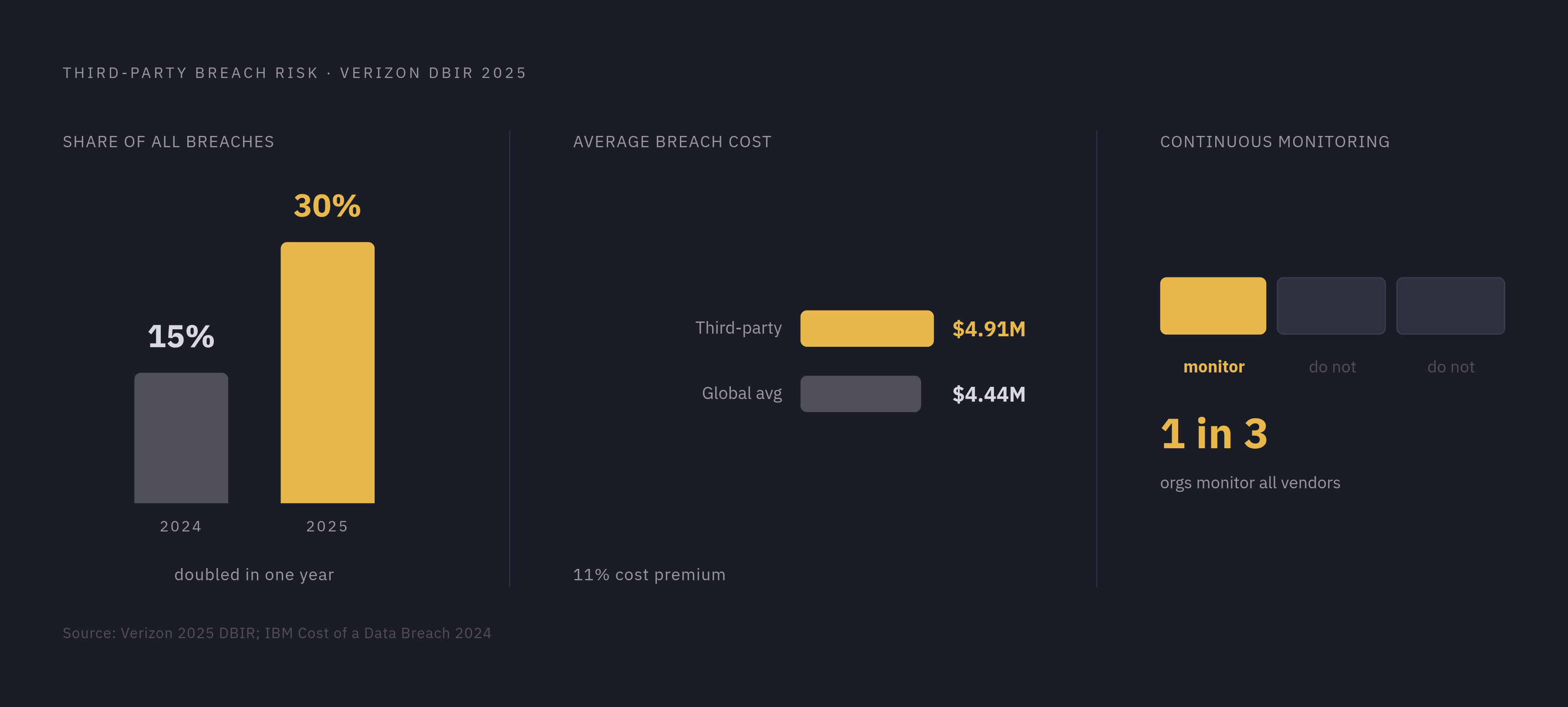
The numbers back up why this matters now. The Verizon 2025 DBIR found that breaches involving a third party jumped to 30%, up from roughly 15% the year before. That's a doubling in a single year, and it's outrunning the pace at which most vendor risk programs can react. The cost side makes the case even harder to ignore: third-party breaches average $4.91 million, against a global average of $4.44 million, an 11% premium that finance teams can put a number on. Yet only one in three organizations continuously monitors all of its third-party relationships for cyber risk. The gap between the risk and the response is the subject of this piece: what signal sources exist, what each one actually catches, and how they fit together into something that deserves the name "monitoring."
What "continuous monitoring" means, and what it does not replace
Continuous vendor risk monitoring is the ongoing, automated tracking of risk indicators across security, financial, operational, compliance, and reputational domains, built to catch changes that could hit the organization before those changes appear in a scheduled review. It is not a replacement for periodic assessments. Assessments still do the job of establishing a control baseline: what the vendor says it does, what evidence backs that up, what contractual commitments exist. Monitoring's job is to detect when that baseline moves. The two are complementary, and a program that leans on one without the other is missing half the picture.
A signal, for the purposes of this piece, is any externally observable data point suggesting a vendor's risk profile has shifted, whether the shift is in security posture, financial condition, regulatory standing, operational behavior, or identity exposure. Some signals are leading and some are lagging, and treating them as interchangeable delays action on the leading signals until they have already become the lagging ones. A vendor's security rating sliding downward over a few weeks is a leading indicator: something is degrading before it turns into an incident. A disclosed breach is lagging: the incident already happened, and the signal is confirmation. A program built entirely on lagging signals is a program that finds out about problems after they've already cost money. The rest of this piece works through the source categories that, taken together, give a monitoring program both kinds of signal.
Security posture signals: external telemetry that shows what vendors are running
This category covers what can be observed from the outside, off a vendor's internet-facing infrastructure, without needing the vendor's cooperation or even its knowledge. It includes cyber risk ratings built off continuous telemetry, things like open ports, TLS configuration quality, patch cadence, and DNS health. It includes vulnerability and CVE exposure mapped against a vendor's known IP ranges, dark web monitoring for credentials tied to vendor domains appearing where they shouldn't, tracking of malware infrastructure for command-and-control links to vendor-owned IP space, and breach database checks for new vendor-associated records appearing in known repositories.
What this catches well: hygiene that's slipping before it turns into a breach, credentials already floating around that a vendor hasn't noticed, and known exploitable flaws sitting on infrastructure a vendor operates. What it does not catch is just as important to name. External telemetry says nothing about internal access governance, nothing about whether contractual security commitments are actually being followed day to day, and nothing about the vendor's financial ability to keep investing in security. A vendor can look clean from the outside while quietly cutting the security budget that keeps it clean. That's a different signal category entirely, which is why relying on security posture data alone leaves the rest of the risk picture dark.
Financial health signals: detecting vendor instability before it becomes your operational problem
This category tracks deterioration in a vendor's financial condition that threatens its ability to keep delivering the service. The sources include credit rating changes and credit bureau alerts, public filing signals like earnings restatements, debt covenant violations, late SEC filings, and going-concern opinions from auditors, plus bankruptcy and restructuring filing monitors and payment behavior data pulled from trade credit networks. For private vendors without public filings, funding and investor signals fill the gap: down rounds, investors pulling out, acqui-hire activity that signals a company is being absorbed rather than growing.
What this catches is insolvency risk building up, disruption coming from an acquisition, security spending getting quietly cut as a cost-saving move, and concentration risk when a vendor the organization depends on heavily starts showing financial strain. The 2024 CrowdStrike outage is a useful illustration of what concentration risk looks like once it materializes, even though that specific incident was operational rather than financial in origin. When Delta Air Lines' crew-tracking software failed during the outage, the airline faced an estimated loss of hundreds of millions of dollars traced back to a single operational dependency. Financial and operational monitoring exists precisely to catch that kind of concentration risk while there's still time to do something about it, rather than after the outage has already grounded flights.
Regulatory and compliance signals: tracking what oversight bodies know that vendors haven't disclosed
This category watches what regulators, enforcement bodies, and standards organizations do publicly; these actions bear on a vendor's compliance standing regardless of whether the vendor mentions them. Enforcement actions and consent orders from bodies like the SEC, FTC, OCC, FCA, and BaFin fall here, alongside sanctions and debarment list monitoring against OFAC, EU, and UN lists. Litigation and class-action filing monitors belong in this category too, along with certification lapse tracking, things like a SOC 2 report expiring, an ISO 27001 surveillance audit turning up findings, or a PCI QSA flagging gaps. Data protection authority decisions and GDPR enforcement notices round it out.
The value here is straightforward: regulators often know about a vendor's control failures well before the vendor volunteers anything, and questionnaires depend entirely on voluntary disclosure to surface the same control failure a regulator has already flagged. The urgency around this category isn't theoretical. DORA has applied since January 17, 2025, and the 2026 Register of Information submissions ran through March 31 for most jurisdictions, with some national authorities setting earlier deadlines. NIS2 has begun issuing its first administrative penalties. Vendors based in the US aren't exempt from the pressure either; they feel both laws indirectly, through the contracts and questionnaires that customers subject to DORA and NIS2 push down the supply chain. Regulatory signal monitoring has stopped being a nice-to-have for programs operating across borders. It's now closer to an obligation.
Reputational and news signals: using open-source intelligence to catch what structured data misses
This category pulls from news media, social platforms, forums, dark web sources, and industry-specific channels, unstructured sources that carry reputational or incident-related risk long before it turns into a structured data point anywhere else. It includes media monitoring for vendor-named breach disclosures, executive misconduct, labor actions, and supply chain disruptions. It includes dark web forum monitoring for vendor data being offered for sale or credentials being traded. It includes social and forum signals, since vendors often post to a status page or mention an incident on Reddit well before any formal notification goes out. Industry-specific threat intelligence sharing through ISACs adds a sector-relevant layer on top.
What structured sources miss, this category often catches: an incident still in its early disclosure phase, a reputational event that appears in coverage before any regulatory action follows, or threat actor activity tied to a vendor that appears in threat intelligence chatter long before it earns a CVE number. That said, this is the noisiest category by a wide margin. Without real filtering and deduplication behind it, news and social monitoring throws off enough false positives to bury a security team in alerts, and a monitoring program that trains its own analysts to ignore alerts is a program quietly defeating its own purpose.
Non-human identity signals: the vendor risk surface most programs cannot currently see
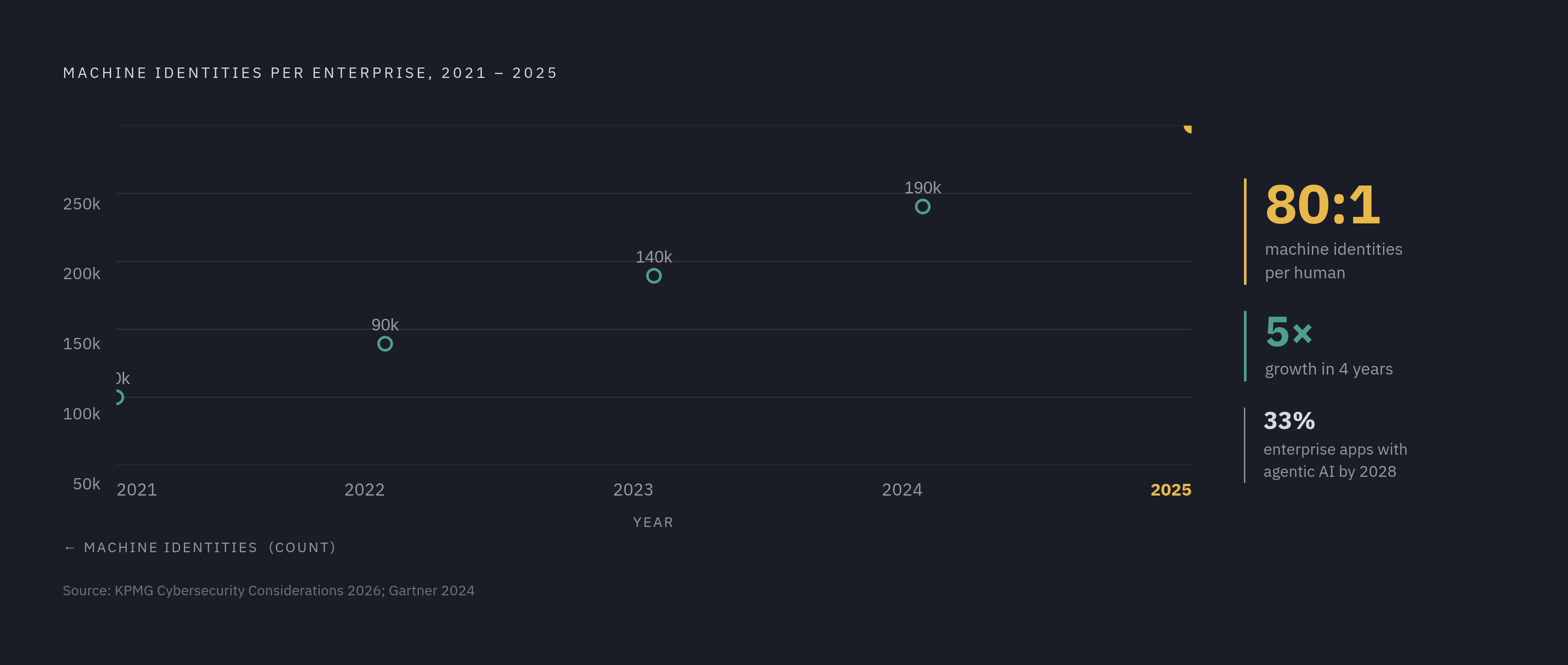
This category tracks the live access relationships between vendor systems and organizational environments, connections mediated by machine identities rather than human logins, and it's the blind spot most vendor risk programs don't even know they have. Non-human identities already outnumber human ones by a wide margin in most modern enterprises. KPMG's Cybersecurity Considerations 2026 report puts the ratio even higher, above 80 machine identities for every human one at the average enterprise, with machine identity counts climbing from roughly 50,000 in 2021 to around 250,000 in 2025 at a typical organization. That's a fivefold increase in four years, and it's not slowing down.
Agentic AI is accelerating the trend further. By May 2026, users of Microsoft Copilot Studio had collectively built more than a million AI agents. Gartner projects that 33% of enterprise applications will incorporate agentic AI by 2028, up from less than 1% in 2024. Every one of those agents is a non-human identity, and a meaningful share of them carry permissions granted by a vendor's integration, not by a human being who remembers granting access.
The signal types to track here include an inventory of OAuth grants, which third-party apps hold live tokens into organizational systems, what scopes those tokens carry, and when anyone last reviewed them. API key and service account monitoring matters too, especially for vendor integrations running on broad or poorly scoped permissions. So does discovery of shadow SaaS integrations that employees set up without going through procurement; those integrations were missing from the vendor inventory from the start. Hardcoded secrets are their own problem: GitGuardian's State of Secrets Sprawl 2026 report found 28.65 million hardcoded secrets added to public GitHub in 2025, up 34% year over year, with secrets tied to AI services rising 81%. More strikingly, 28% of secrets incidents now start outside code repositories entirely, in tools like Slack, Jira, and Confluence, and those are 13% more likely to be flagged as critical than a leak found in code. Agent identity audit logs finish the picture: telling apart what an AI agent did from what a human did, and confirming agent credentials are scoped narrowly, expire quickly, and can be traced back to a specific action.
Operational and fourth-party signals: the risk that lives one layer below your vendor list
This category watches a vendor's own dependencies: the cloud providers, subcontractors, and critical SaaS tools the vendor itself relies on to deliver the service it's selling. Fourth-party change notifications flag when a vendor adds, swaps, or loses a critical subcontractor. Concentration risk signals catch something subtler: several of an organization's critical vendors quietly sharing the same cloud region, the same CDN, or the same DNS provider; this dependency stays invisible until that one shared provider goes down and takes several vendors offline at once.
Vendor SLA performance data adds a lagging but still useful signal, since a rising frequency of breached service-level agreements tends to precede a bigger failure. Status page and incident feed monitoring often beats formal disclosure by hours or days, since vendors update their own status page in real time long before legal and communications teams sign off on an official statement. Subcontractor regulatory and certification signals extend the same compliance tracking used for direct vendors down one more level, into the parts of the supply chain that don't show up on the vendor list at all, because no one built the list expecting to look for them there.
Put these seven categories together, security posture, financial health, regulatory standing, reputational signals, non-human identity, and fourth-party dependencies, and the resulting picture is a program that can see a vendor's risk shift while it's still shifting, not months after the fact when an assessment finally comes due. The pieces exist. What's missing in most programs is the decision to go collect the data. It's the decision to go collect it.