Third-Party Incident Response Playbooks for Risk Teams
Playbook templates designed specifically for vendor breaches.

Most third-party incident response plans fail before the first alert even fires, because they're internal IR plans with vendor names swapped in. That approach breaks immediately: an organization can't patch a vendor's system, can't compel forensic access to a vendor's environment, and can't dictate how fast a vendor moves once it's compromised. A real playbook has to be built around that lack of control from the ground up, starting with the data underneath it and ending with coordination protocols that make escalation possible in the first hour rather than the third day.
The numbers explain why this matters now. Supply chain compromise incidents have a mean lifecycle of 267 days, the longest of any attack vector tracked, and IBM's 2025 Cost of a Data Breach research puts the average breach cost at $4.91 million. That length is coordination overhead, plain and simple: waiting on a vendor to confirm scope, waiting on legal to interpret a contract clause, waiting on a fourth-party subcontractor to even pick up the phone. Verizon's Data Breach Investigations Report found that 30% of all breaches involved a third party, up from 15% the year before. The gap between "something happened at a vendor" and "a risk team opened a ticket" is where most of the damage compounds, and it's a gap most programs still treat as an afterthought.
The vendor lifecycle data a playbook must be built on top of
None of the response stages that follow work if the underlying vendor records are stale or incomplete. A playbook can't route escalation to the right contact, invoke the correct contract clause, or size the blast radius of an incident if nobody trusts the data behind it.
Six things need to be in place before an incident, not during one: a current vendor inventory (who's active, what data they touch, what systems they connect into), a risk tier and criticality classification (a payroll processor and an office supply vendor don't warrant the same response speed), a fourth-party map showing which subcontractors sit behind each critical vendor, contract metadata covering notification obligations and audit rights and breach response SLAs and termination triggers, named escalation contacts at each vendor, and the most recent assessment findings along with any remediation items still open. That fourth-party map determines exposure that most programs fail to account for: 4.5% of all breaches are now fourth-party incidents, and 12.7% of third-party breaches extend into a fourth party.
Most programs only track roughly 40% of their vendor population at this level of detail, even in mature third-party risk management setups. The remaining 60% sits inside the playbook's coverage as a blind spot nobody's named yet. Fewer than 25% of programs describe themselves as highly coordinated across teams, and nearly half point to departmental silos as the main obstacle. Silos don't just slow things down. They produce split vendor profiles, procurement holding one record, security holding another, legal holding a third. During an actual incident, that means three teams give three different answers about the same vendor, often to the same executive, on the same call.
Continuous monitoring feeds that activate the playbook before a ticket is opened
A playbook that waits on an analyst to notice a vendor problem and open a ticket is already behind. That 267-day average lifecycle is what happens when undetected third-party exposure sits there while nobody's watching the right signal. It's what happens when undetected third-party exposure sits there while nobody's watching the right signal.
A handful of concrete triggers should activate a playbook stage on their own, without a human deciding to go looking: threat intelligence feeds flagging a vendor in a disclosed breach or ransomware incident, security rating drops or certificate and configuration anomalies on vendor-facing infrastructure, news and regulatory monitoring catching enforcement actions or sanctions or sudden leadership turnover, fourth-party alerts where a subcontractor compromise touches a vendor the organization depends on, and missed contract obligation deadlines, which are themselves a signal worth acting on rather than filing away. OAuth and API connection anomalies belong on that list too, and they get their own treatment further down given how much damage they've caused recently.
A point-in-time audit only tells an organization the vendor was compliant on the day the questionnaire came back. It says nothing about the six months after. Continuous monitoring is the only mechanism that tells the organization what's changed since, and treating an annual assessment as if it still holds half a year later is how a vendor's posture drifts until the ticket finally opens.
The five stages every third-party IR playbook must contain
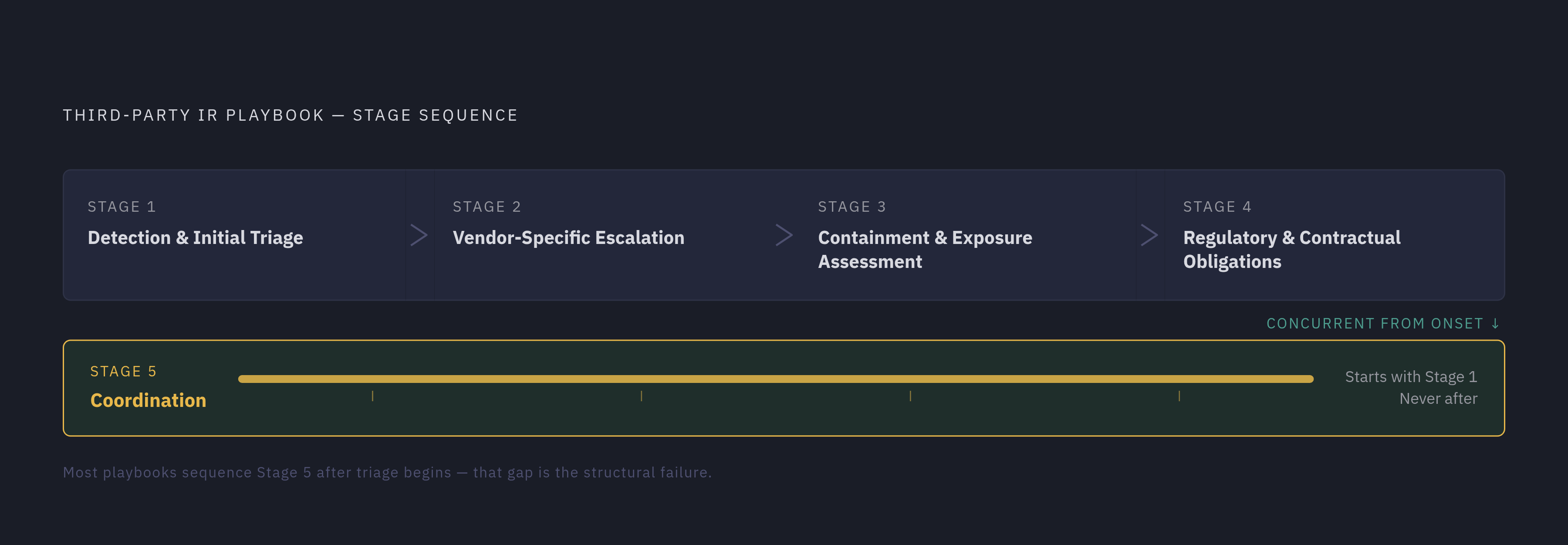
Stage 1 is detection and initial triage. The incident might surface through a monitoring alert, a vendor's own notification, a regulatory disclosure, a news report, or something an internal team stumbled into. The first questions that need answers: which vendors are affected, what data or systems fall in scope, what tier that vendor is. An incident owner gets assigned immediately, a named person rather than a committee that has to figure out who's driving. The vendor record gets pulled: last assessment date, open findings, contract notification provisions. Then comes the decision gate: does this clear the threshold for escalation, or does it sit as a watch item for now?
Stage 2 is vendor-specific escalation. This means activating a pre-built escalation path rather than firing off an email to a generic vendor management inbox. Contacts should be tiered into a primary operational contact, a CISO-level contact, and a legal or contractual contact, each reachable independently. Formal written notification goes out invoking the specific contract provisions, which preserves the audit trail and starts the SLA clock. The vendor gets a defined window, one the contract should already specify, to return an incident timeline, scope assessment, and remediation plan. Internal legal gets pulled in early if there's any chance regulatory notification obligations get triggered downstream.
Stage 3 is containment and exposure assessment. This is where the lifecycle data layer either earns its keep or falls apart under pressure: assessing what data the vendor holds, processes, or transmits depends entirely on that inventory already existing rather than being reconstructed on the fly. Fourth-party exposure gets mapped, since the vendor's vendor might need contacting too. Someone has to decide whether access gets suspended outright, throttled, or monitored at a higher frequency while the investigation runs. Connected OAuth grants, API keys, and service account credentials get checked for possible revocation, a topic that earns its own section below. Every containment action gets documented along with the reasoning, because regulatory examiners will ask for exactly that later.
Stage 4 is regulatory and contractual obligations. The incident gets mapped against whatever regulatory frameworks apply. Under DORA, designated bodies identify critical ICT third-party providers, and financial entities have to keep a register of information on all their ICT third-party providers, with incident reporting obligations spelled out explicitly. The NCUA's 2026 supervisory priorities, laid out in Letter 26-CU-01, now surface third-party risk inside lending, payment, and BSA exams instead of confining it to the annual TPRM review. The FFIEC retired its Cybersecurity Assessment Tool on August 31, 2025, and pointed institutions toward NIST CSF 2.0, the CRI Profile, CISA's Cybersecurity Performance Goals, and CIS Controls instead. FINRA's 2025 Annual Regulatory Oversight Report names third-party governance as an explicit supervisory concern in its own right. Beyond mapping the framework, the team has to check the vendor's breach against the organization's own notification obligations to regulators or customers, and pull the contract again for right-to-audit, right-to-terminate-for-cause, indemnification, and breach notification SLAs. A vendor record split across lending, compliance, and IT produces something specific and bad: three teams giving three different answers to the same examiner during the same exam cycle.
Stage 5 is the coordination layer that runs concurrently with the other stages rather than after them. It's the coordination layer, covered in its own section further down, because it can't be improvised once Stage 1 has already started.
Non-human identities as a distinct incident category the playbook must cover
Traditional vendor assessments evaluate the vendor as an entity: its policies, its certifications, its questionnaire answers. What they don't govern are the live OAuth grants, API connections, and service account credentials sitting in the background, the actual conduit data moves through day to day.
The August 2025 breach targeting Salesforce customer instances through compromised OAuth tokens tied to the Salesloft Drift AI integration makes the point concretely. Attributed to the threat actor UNC6395, it impacted more than 700 organizations. The exposure wasn't a weak spot anyone's questionnaire would have caught. It was an OAuth grant that had existed quietly in the background, doing its job, until it became the entry point.
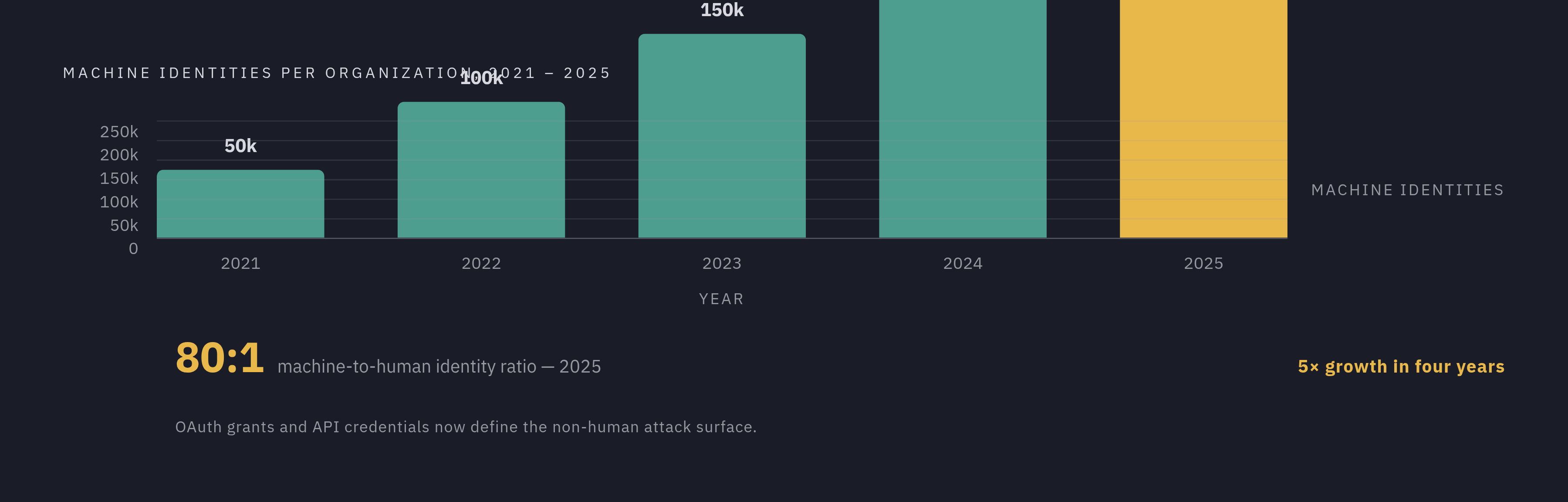
KPMG's Cybersecurity Considerations report puts the ratio of machine identities to human identities above 80-to-1 at a typical organization, with the raw count climbing from roughly 50,000 in 2021 to around 250,000 in 2025. KPMG's Cybersecurity Considerations report puts the ratio of machine identities to human identities above 80-to-1 at a typical organization, with the raw count climbing from roughly 50,000 in 2021 to around 250,000 in 2025. GitGuardian's State of Secrets Sprawl 2026 report found 28.65 million hardcoded secrets added to public GitHub in 2025 alone, up 34% year-over-year, with secrets tied to AI services up 81%. A meaningful share of that sprawl is third-party credential exposure, sitting in code, waiting. A playbook that treats the vendor purely as a legal entity and ignores the non-human identities connecting to it is covering maybe half the actual attack surface. That is a significant, non-trivial exposure. The incident has another side to it as well.
Pre-built coordination protocols cannot be drafted during an incident
Everything in Stage 2 depends on agreements that have to exist before the incident starts: notification windows, audit rights, breach response SLAs, named contacts, data return and destruction obligations. None of that gets negotiated in the middle of a live event, because the vendor has zero incentive to agree to fast timelines once something has already gone wrong.
Compliance team involvement in third-party risk management rose from 42% in 2023 to 88% in 2025, which sounds like progress until it's paired with the fact that fewer than one in four programs describe themselves as highly coordinated. Broad involvement without coordination doesn't speed things up. It slows them down, because more people now hold a stake in the decision without a clear structure for who actually decides.
Internal coordination has to be built out ahead of time with a clear RACI: who detects, who triages, who owns vendor communication, who brings in legal, who notifies regulators, who briefs the board. Decision authority thresholds need setting in advance too, spelling out what severity level triggers executive notification and what triggers actual contract termination talks. Communication templates for vendor notification, internal stakeholder updates, and draft regulatory notifications should already exist rather than getting written from scratch under deadline pressure. And there needs to be a defined handoff protocol between the security team running technical incident response and the risk team running vendor response, since these frequently sit in separate departments with no established interface between them.
External coordination needs the same advance work. Named contacts with actual incident response authority need to exist at every Tier 1 and Tier 2 vendor. Someone needs pre-agreed clarity on which regulator gets notified under which framework and who inside the organization makes that call. And a defined mechanism for requesting subcontractor information from a primary vendor has to exist before a fourth-party issue occurs, since vendors are rarely forthcoming about who's behind them once asked cold.
AI-assisted monitoring and assessment's effect on what the playbook can realistically promise
Part of why the 267-day lifecycle stretches as long as it does comes down to staffing and tooling, not just process design. Compliance professionals report spending somewhere between 30% and 50% of their time on manual, repetitive work, questionnaire review, evidence chasing, spreadsheet reconciliation, which leaves little room for the active, continuous monitoring a playbook needs to trigger early.
AI-assisted tools change what's realistic to promise inside a playbook mainly by narrowing the gap between signal and action. Monitoring systems that flag a rating drop, a certificate anomaly, or a fourth-party alert without a human checking a dashboard every morning shift detection from periodic to continuous, closing exactly the lag that lets exposure sit undetected for months. Assessment tools that process contract language, flag missing notification clauses, or cross-reference vendor inventories against known breach disclosures cut into the manual load eating a third to half of compliance teams' time. None of this replaces the judgment calls in Stages 2 through 4. A person still has to weigh the tradeoff of terminating a vendor relationship, or decide independently whether a fourth-party exposure rises to reportable status.
What changes is how early the playbook gets a reliable signal to act on, and how much of the lifecycle data layer stays current without someone updating it by hand. A playbook built on stale inventory and manual triage can promise thoroughness, eventually. One built on continuous, AI-assisted monitoring can promise speed. Given a 267-day average lifecycle for the costliest attack vector on record, speed is the thing that's been missing.