Inherent Risk Scoring Models for New Vendor Requests

Inherent risk scoring models for new vendor requests replace gut feel with a repeatable basis for deciding how much scrutiny a relationship deserves. Their value depends on the inputs they capture and the decisions their scores trigger. A defensible model measures exposure before controls, then connects that exposure to proportionate due diligence, approval requirements, and monitoring.
Why the first moment a vendor enters the pipeline is the highest-leverage point in your entire TPRM program
A new vendor request lands in the queue, and someone must decide immediately how seriously to treat it. That decision allocates analyst time, questionnaire depth, evidence requirements, approval authority, and monitoring frequency. The consequences extend well beyond the initial assessment. Under-scoring leaves important exposure under-examined, while over-scoring commits resources to work that offers little risk reduction. Both errors compound throughout the relationship.
A cloud hosting provider and an office supply vendor present different exposure patterns, yet an uncalibrated intake process can route both through the same full assessment. ProcessUnity’s State of Third-Party Risk Assessments 2026 Report found that a majority of assessments consume more than 40 manual hours across internal teams. That workload makes poor allocation expensive to sustain.
What inherent risk actually measures, and what it does not
ProcessUnity defines inherent risk as “the baseline level of risk that a third party presents before any mitigating controls are applied”. It measures the exposure created by the relationship. A vendor still has privileged system access even when its controls are strong. Conversely, weak security at a vendor with no data access and no business criticality does not, by itself, establish high inherent risk.
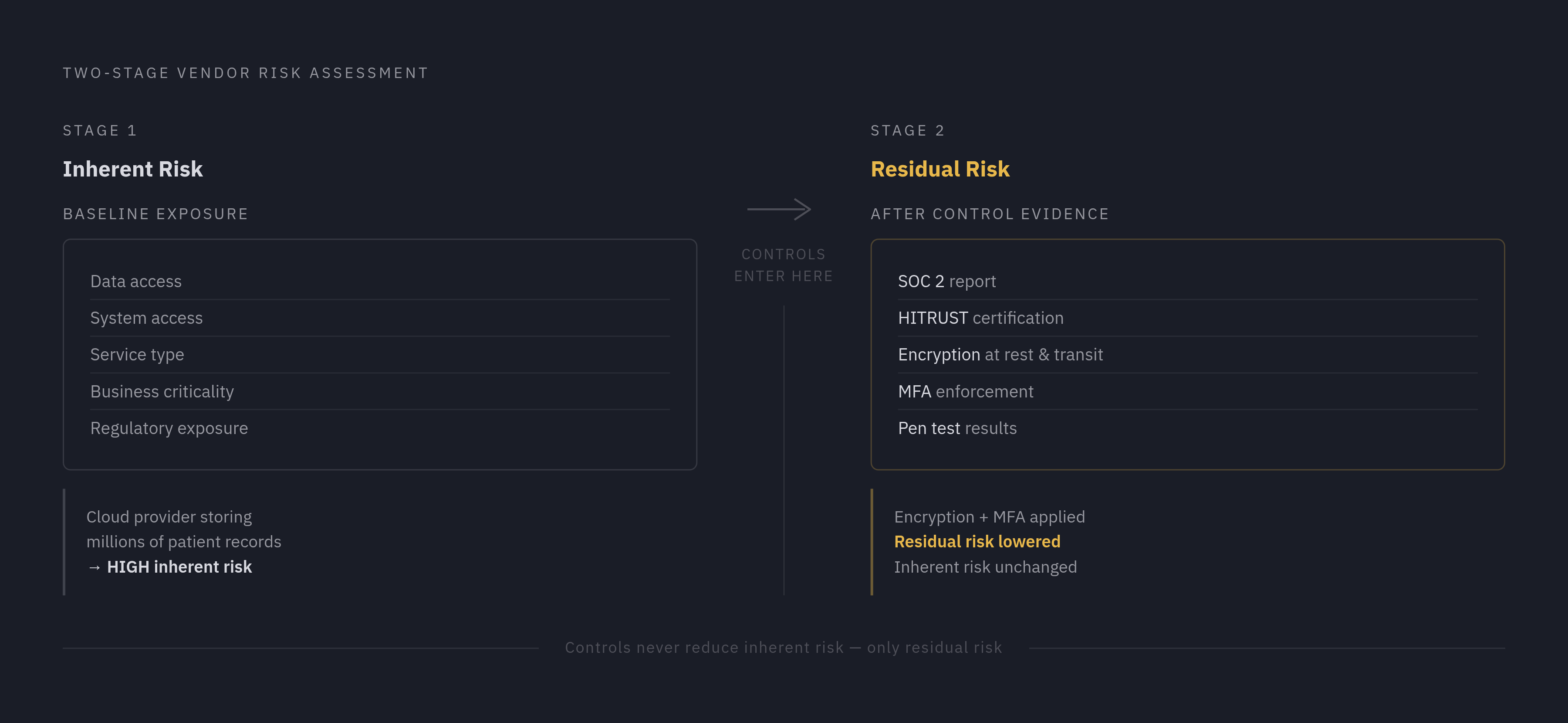
The distinction separates two decisions that must occur in sequence. Inherent risk sets how much due diligence is needed, while residual risk uses control evidence to judge whether the exposure left over is acceptable. Censinet illustrates this distinction with a medical device manufacturer that has direct access to clinical systems. That access establishes the baseline exposure before HITRUST certification enters the assessment. Crediting the certification at intake would mix the two stages and potentially reduce scrutiny before controls have been evaluated.
The five input dimensions that a defensible inherent risk model must capture
Service type establishes what kind of exposure the relationship creates. ProcessUnity identifies it as the first dimension because technology, operational, data handling, compliance, and business continuity risks do not always travel together. A managed IT services provider and a facilities vendor can enter the same premises while presenting very different threat surfaces.
Data access and sensitivity establish what information the vendor can access, process, store, transmit, modify, or delete. The model must distinguish the activity from the sensitivity of the information involved. In healthcare, PHI access is the primary tier driver, while payment data or trading-system access has equivalent significance in financial services. This exposure can change after onboarding. ProcessUnity therefore recommends reviewing data access on a regular cadence rather than treating the original answer as permanent.
System and network access show what permissions a vendor has beyond what data volume alone can reveal. A vendor with privileged infrastructure access can be high-risk even if it processes little information. ProcessUnity includes IT operations, cloud environments, software integrations, and infrastructure administration in this dimension. API integrations, remote access, OAuth tokens, and SaaS plugins belong in the same assessment of system reach.
Business criticality measures the disruption that an outage, breach, or termination would cause to operations, customer delivery, or revenue. An email provider and a project management tool used by one team may both be SaaS, but their failure would have different consequences. Onspring identifies criticality as a core criterion for setting assessment rigor and monitoring cadence.
Regulatory and compliance exposure covers harm that can go beyond direct damage to operations. The model must account for obligations associated with DORA, HIPAA, NIST CSF, ISO 27001, or sector-specific rules, as applicable to the relationship. Geography and fourth-party dependencies also belong here when jurisdictions or subprocessors introduce exposure. This dimension remains separate from data sensitivity because the regulatory consequence is not reducible to the information involved. All five dimensions are necessary, and strength in one cannot compensate for omitting another.
Three scoring model architectures and when to use each
A weighted scorecard assigns weights summing to 100, scores each dimension on a consistent scale, and combines the results into a composite number. Censinet identifies this architecture as particularly suited to large vendor portfolios and board-level reporting because vendors can be compared directly. Its logic is also open to inspection. An auditor or business owner can trace the tier back to the scores and weights, making this a strong fit for diverse portfolios with multiple stakeholders.
An inherent-versus-residual model establishes baseline exposure first and evaluates control evidence afterward. Certifications, audit results, and penetration test findings inform the second calculation. Censinet illustrates the approach with a cloud provider storing millions of patient records. Encryption, MFA, and regular audits may lower residual risk, but the relationship still has high inherent risk. This architecture is the best fit for regulated organizations that must show the order in which they made those judgments.
A likelihood-impact matrix scores the probability of a risk event and its consequences on separate axes, then multiplies them into a risk priority number. Its visual layout makes it easier to triage risks quickly and explain them to non-technical stakeholders. The distinction between scoring stages still applies. A matrix that incorporates outdated software or control weaknesses is not measuring only baseline relationship exposure. Architecture should therefore follow audit requirements, vendor population size, and communication needs.
The input category most inherent risk models currently ignore — non-human vendor identities
The five dimensions cannot assess a relationship that never reaches intake. An employee can connect a SaaS tool or AI agent through an OAuth consent screen and authorize third-party access without submitting a vendor request. The scoring model never sees that connection. Non-human vendor identities can go unassessed even when the model’s calculations are sound.
Google Threat Intelligence Group described how attackers targeted Salesforce customer instances using compromised OAuth tokens tied to the Salesloft Drift third-party application in the Salesloft-Drift incident in 2025. Attackers also got into Vercel’s internal environment through a compromised Context.ai application. Context.ai’s bulletin stated that a Vercel employee appeared to have signed up for its consumer AI Office Suite using a corporate account and granted “Allow All” permissions.
Microsoft’s Entra Agent ID, generally available by April 2026, automatically assigns agents built in Copilot Studio or Microsoft Foundry a first-class Entra identity and supports OAuth, MCP, and A2A protocols. The model extension is to subject third-party agents, integrations, and AI tools connecting to enterprise systems to the same intake and scoring as traditional vendors. Scoped OAuth token issuance rather than broad API key grants, together with contractual security requirements, connects that assessment to access governance.
How regulatory frameworks — DORA in particular — are making inherent risk model quality an enforcement question
DORA has applied to EU financial entities from January 2025, with substantial penalties for serious breaches. Article 28 requires an ICT third-party risk strategy that is written down and for which the management body is accountable. A standalone questionnaire process does not satisfy that requirement. The organization must be able to explain how its assessment approach reflects the exposure created by each relationship.
A weak or undocumented model leaves the firm without a defensible explanation for the scrutiny it applied before contracting. DORA’s reach to ICT third-party service providers regardless of headquarters also makes SaaS plugins and AI tools relevant when they provide ICT services to EU financial entities.
In KLAS Healthcare Cybersecurity Benchmarking, Supply Chain Risk Management and Asset Management have the lowest coverage scores for the third consecutive year. Censinet notes that scoring models must support HIPAA compliance. Together, these requirements and coverage gaps sharpen the need for documented inputs, scoring logic, and assessment decisions rather than questionnaires collected without a clear risk basis.
Where AI automation fits into the scoring workflow — and where it does not replace judgment
AI can reduce manual work across intake, due diligence, and monitoring without collapsing those stages into one calculation. Intake agents can pre-screen vendors and catch duplicates, while due diligence agents analyze SOC 2 reports and flag thin or contradictory answers. Continuous monitoring can recalculate scores as new information arrives. Confidence scores and source logging support human review of judgment calls. Control evidence must still feed into residual risk, with baseline exposure kept unchanged.
ProcessUnity’s combined Inherent Risk Questionnaire + Auto Inherent Risk capability illustrates a comparison-based approach. It aggregates inherent risk scores from similar organizations in a shared exchange into a base score, then compares that result with internally attested scores to identify discrepancies. The discrepancy creates a reason for deeper review. It does not replace the organization’s judgment about its own relationship with the vendor.
Poor data quality, inconsistent forms, and legacy integration gaps constrain the value of automation. Riskonnect identifies configurable scoring models as a core platform capability for keeping third-party risk within defined risk appetite thresholds. The practical implication is that automation should follow the organization’s frameworks and decisions. Zero-touch assessment is appropriate for low-risk vendors because analysts’ judgment is better spent on relationships the model identifies as genuinely complex.
Building the intake questionnaire that feeds the model reliable inputs
ProcessUnity positions the inherent risk questionnaire as a standard intake form completed by the person or department requesting the vendor. That business owner knows the intended service, its operational importance, and the information to be shared. The form must fit that person’s knowledge. Questions should therefore be concrete and operational, requiring only the business owner’s knowledge.
Each question should map directly to service type, data access, system access, business criticality, or regulatory exposure. Questions that do not map to a scored dimension should stay out of the intake form. To include non-human identities, the form should ask whether the vendor will connect through API, OAuth, or SaaS integration and require the requestor to name the systems. This makes the connection an explicit scoring input.
Consistency is what makes those answers useful as evidence. If two business owners describe similar relationships differently because the form is ambiguous, the resulting tier difference cannot be defended through calculation alone. Automation would only process that ambiguity faster. The intake form is therefore a risk control, and its design is as consequential as the model it feeds.
Translating the score into a tier structure that drives concrete downstream decisions
Onspring describes risk-based tiering as a way to “right-size assessment rigor and monitoring cadence”. Before the model goes live, the actions each tier triggers must be set. A label alone cannot direct an analyst’s work. Each tier should state the questionnaire type or zero-touch route, what evidence is needed, how often monitoring takes place, and who has approval authority. Evidence requirements can include SOC 2 reports, an ISO 27001 certificate, and penetration test results, according to the assigned exposure.
Tier definitions must also state when the original calculation is no longer valid. Changes in data access, new system integrations, changed business criticality, and material vendor events should trigger re-scoring before the next scheduled review. ProcessUnity’s prioritization logic assigns deeper due diligence and more detailed control reviews to high-risk relationships, with proportionate scrutiny for lower-risk vendors. Documented triggers keep that allocation aligned with the relationship as it evolves.
For firms under DORA, the board-approved programme must document the connection between the tier and assessment depth. Supervisory assessments examine whether pre-contract evidence corresponds to the assigned risk level. Thin pre-contract evidence for a critical vendor is still a weakness even after a strong later assessment. This is why intake has such leverage over the vendor lifecycle. A documented tier structure turns the initial calculation into audit-defensible evidence that subsequent decisions follow the organization’s risk appetite.