Vendor Onboarding Bottlenecks in Regulated Industries
Fragmented approval workflows create wait times that regulators scrutinize.

Vendor onboarding delays in regulated industries stem from fragmented architecture. When approvals are disconnected, handoffs happen one at a time, and risk assessments are kept apart from access decisions, each stage has to wait on the last. Fixing that structure requires risk-based routing, coordinated reviews, and an onboarding record that supports the vendor relationship long after approval.
Why vendor onboarding in regulated industries is an architecture problem, not a process problem
Process complexity is how many steps onboarding has. Process architecture describes how those steps connect. A regulated organization can need extensive due diligence without needing every review to wait for the previous one. The distinction is important because a checklist adds work inside an existing sequence, while an architecture change alters the sequence itself. The number of controls does not explain how much time vendors spend waiting between them.
The waiting pattern exposes the underlying fragmentation. Procurement waits for legal, legal waits for compliance, and compliance waits for IT. Each handoff becomes a queue rather than a coordinated part of the workflow, so removing one delay simply moves the blockage downstream. Regulated environments intensify the consequences because pressure to begin work can separate access decisions from unfinished due diligence.
Where the specific bottlenecks form across the onboarding sequence
Tax IDs, insurance certificates, compliance attestations, and security evidence come in through different channels and stay with different owners. There is no shared version history. Teams then spend time locating documents and deciding which copy is current, leaving less time to evaluate the vendor. The same fragmentation later prevents auditors from reconstructing which evidence supported the original approval.
When assessment comes late in the sequence, teams collect a lot of evidence before they know whether the vendor needs a close review or a streamlined path. The effort precedes the decision that should govern it. Requiring the same evidence from every vendor uses up time and resources on low-risk relationships, while pressure to make up lost time can lead teams to take shortcuts on high-risk ones. This bottleneck is not simply a slow assessment but an assessment positioned too late to organize the work.
The contract-to-access handoff separates approval from its operational effect. Access then enters a separate IT ticketing process. Without a link to the completed risk assessment, the handoff can fail in either direction, with access granted before due diligence finishes or withheld after it is complete. A signed contract does not, by itself, resolve that disconnect.
Ownership gaps make the other handoffs harder to settle. A contract may exist without a clear relationship owner, a defined trigger for risk review, or an agreed route for escalating a stall. At every handoff, teams then have to agree again on who is responsible. This gap sits between internal teams, where no one has explicit accountability for moving the relationship through the next decision.
How regulated environments turn each bottleneck into a compounding liability
The OCC, Federal Reserve, and FDIC’s 2023 interagency guidance says that due diligence before choosing and entering third-party relationships is an important part of sound risk management. Delay alone is not the regulatory failure. The exposure arises when disconnected workflows allow the relationship to begin without the diligence needed to support it, or leave the organization unable to demonstrate what informed its decision.
DORA, enforceable across EU financial services from January 17, 2025, mandates detailed contractual provisions and ICT risk assessments before onboarding ICT third-party providers. Providers that support critical or important functions have to meet stricter requirements. Separately, the agencies’ April 2026 model risk management updates adopt a more flexible, principles-based approach to third-party model validation. That flexibility still depends on understanding the vendor’s risk early enough to make a proportionate decision.
Verizon’s 2026 Data Breach Investigations Report found that third parties were involved in 48% of all breaches. In healthcare, the concentration of third-party breaches makes onboarding gaps a patient-safety and financial concern as well as a compliance concern. The consequences extend beyond the approval date. Missing evidence, incomplete assessments, and unclear access ownership weaken the basis on which a relationship is accepted, while disconnected records make later investigation harder.
Across regulated sectors, written policies and deployed tools can coexist with these structural weaknesses. Documentation is not evidence that the workflow functions. Financial institutions relying on manual processes are substantially more likely to receive exam findings than those using dedicated software, but the distinction is not simply whether software is present. The relevant gap is between a documented program and one whose evidence, decisions, and responsibilities remain connected in practice.
The non-human identity gap that onboarding almost never covers
The access-provisioning bottleneck extends beyond accounts assigned to people. Third-party tools acquire OAuth tokens, service accounts, API keys, and AI agent credentials during or after onboarding, often outside the risk assessment and approval workflow. Traditional controls focus on named users, login credentials, and role assignments. As a result, an organization can complete its human access checks without reviewing the application identities entering its trust boundary.
The OWASP Non-Human Identities Top 10, published December 2024, lists “Vulnerable Third-Party NHI” as NHI3:2025. The risk includes exposure inherited from a vendor’s or integration partner’s non-human identity hygiene, such as a compromised SaaS-to-SaaS OAuth grant. If the workflow never captures the grant, its scopes, or its owner, the access decision sits outside the controls that approved the vendor relationship.
AI agents make that omission more consequential. OAuth 2.0 was not designed for autonomous agents that spawn sub-agents, execute multi-step workflows without a human in the loop, or blend delegated user authority with persistent machine identity. Employees also authorize third-party AI tools with delegated OAuth access into enterprise tenants. Each authorization introduces an application identity, often with scopes nobody reviewed and no assigned owner. The architectural failure is that these identities can enter through the vendor relationship without entering the onboarding process.
Why the information collected at onboarding decays without lifecycle integration
Even when onboarding evidence is complete, it is less useful if it is kept apart from the systems used to manage the relationship. Vendor contacts, compliance documents, and risk ratings may be collected at intake but never become part of a usable lifecycle record. Annual reviews then ask for the same information again. The organization pays again for work already performed because onboarding outputs do not feed monitoring, contract management, or periodic review.
The loss is not limited to duplicated effort. A vendor compliant at approval can fall out of compliance six months later through an expired certification, lapsed insurance, or changed subcontractor arrangements. Without a system that records the change, the original assessment remains the visible account of a relationship that has moved on. An audit or incident may become the first trigger for reassessment. The intake record is then historical evidence.
Contract obligations decay in a similar way. SLAs, escalation paths, and data handling obligations set during onboarding can sit in a signed document without anyone checking whether the vendor follows them. Approval closes the administrative task but leaves the operating relationship disconnected from its controls. This is why a fix confined to intake is incomplete. A well-architected onboarding process begins the monitoring relationship.
What a well-architected onboarding process actually looks like
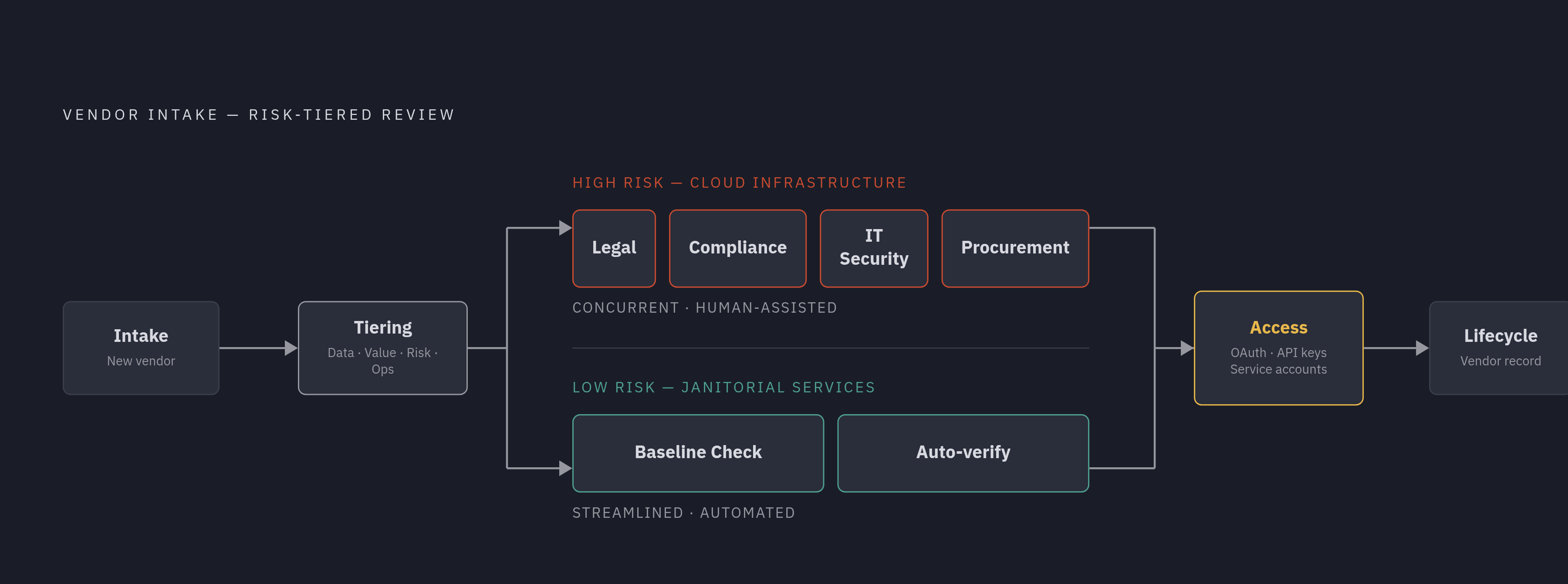
The operational response is to determine the review path before evidence collection begins. Vendors should be tiered at first engagement by data access level, contract value, regulatory exposure, and operational criticality. Low-risk vendors should follow a streamlined path with baseline controls verified automatically, while high-risk vendors receive proportionate scrutiny from the start. The paths should differ for a reason. A janitorial services vendor and a cloud infrastructure provider present different risk profiles, so identical requirements waste effort without establishing equivalent protection.
Legal, compliance, IT, and procurement reviews should then run concurrently where possible, triggered by a single intake event. Concurrency removes waiting that serves no control purpose while preserving required decisions and due diligence before access. Explicit SLAs and role-based approvals should define responsibility at each stage, replacing the assumption that another team is handling the next step. Relationship ownership and escalation responsibility should also be settled for all handoffs.
Access provisioning should include non-human identities in the same workflow as human credentialing. OAuth scope review, service account inventory, and AI agent authorization should not depend on a separate security review that may never happen. Each third-party application identity should have an assigned owner and a review trigger before access is granted. This closes the parallel route into the organization. It also connects the vendor’s assessed risk with the access its tools actually request.
Onboarding outputs should feed directly into the vendor’s lifecycle record. Risk ratings, compliance artifacts, contract obligations, and contacts should be available to the monitoring system, contract management layer, and next review cycle without being collected again. Continuous monitoring should flag certifications that are about to expire, changes in subcontractors, and changes in security posture, then send the findings back into the risk record automatically. The initial assessment becomes a starting point. Subsequent decisions can then use changes in the relationship rather than repeatedly reconstructing its original state.
Documentation integrity should support all of these connections. Centralized storage, version control, and audit trails should keep both the latest files and the evidence used to make decisions. When an examiner requests proof of insurance coverage from six months ago, the record should be retrievable in minutes, eliminating the need for reconstruction from email threads. That retrieval depends on the architecture established at intake.
The objection worth taking seriously: automation without tiering accelerates the wrong things
The strongest objection to this approach concerns automation applied before the structure changes. Without intake tiering, automated collection can ask every vendor to meet the same requirements while teams still do just as much high-risk analysis by hand. Faster execution of an inappropriate review path can increase the volume of low-value work reaching the same constrained reviewers.
Standardization also has a legitimate limit. Some vendors, especially those in regulated industries themselves, need onboarding tailored to their needs. A workflow that treats every exception as a departure from the system can create a new bottleneck where the old one was removed. Teams should be consistent in how they make decisions while allowing requirements to differ from one relationship to the next. The architecture must allow for the differences found in the risk assessment.
Tiering is therefore a prerequisite for useful automation. Low-risk vendors can get zero-touch assessment through automated controls, while high-risk vendors get a deeper, human-assisted review, with each path using as much automation as fits its level of risk. Analyst time should concentrate where risk concentrates. To sustain that allocation, the architecture should adapt to the organization’s control frameworks, learn from team decisions, and become more accurate over time. The test is not how quickly onboarding reaches approval, but whether its structure directs the right scrutiny to the right relationship and keeps that judgment connected to access and ongoing review.