Autonomous Evidence Gathering for Vendor Assessments
Continuous monitoring replaces outdated snapshots with real-time vendor risk visibility.

A risk review closes. Hundreds of vendors assessed, findings resolved, a report delivered to the board. Within weeks, the exposure that report described no longer exists, because the underlying systems moved on without waiting for the next cycle. That gap between when a vendor was assessed and what a vendor is doing right now is the subject of this piece: traditional assessment programs produce the appearance of oversight, and autonomous evidence gathering is becoming the only way to produce oversight that actually holds up when someone asks for proof.
Why periodic vendor assessments create a defensibility gap
The quarterly or annual review cycle was built on a quiet assumption: that a vendor's risk profile, once assessed, would stay roughly where it was found until the next scheduled look. That assumption is failing. Sprinto's Vendor Category Landscape 2026 report analyzed sixteen vendor categories and found that a significant portion now show elevated runtime control dependency, exposure shaped not just by a vendor's own governance maturity but by internal configuration choices, user behavior, how deeply a tool is integrated, AI-driven automation, and shifting data ingestion patterns. Those variables move on a weekly or daily rhythm rather than a quarterly one.
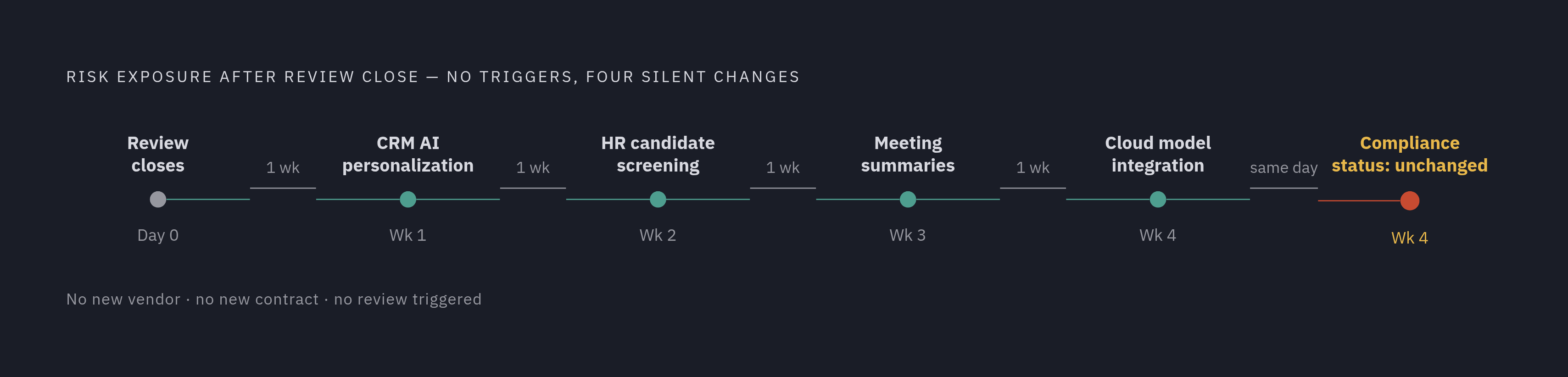
The same report offers a scenario that makes the problem concrete rather than abstract. A global risk review closes. A month later, the marketing team turns on a new AI personalization module inside the CRM. HR activates AI-driven candidate screening. The collaboration suite rolls out AI meeting summaries across the company. The cloud provider expands a model integration layer. None of this involves a new vendor, a new contract, or anything that would trigger an onboarding review under a typical program. Runtime exposure has changed in a material way, and the paperwork that says otherwise is still sitting in the compliance folder, technically accurate and functionally obsolete.
Once exposure depends this heavily on what's happening inside a vendor relationship right now rather than what was true when the contract was signed, the core failure is no longer operational but evidentiary. The evidence a team collected last quarter may no longer describe how the system behaves today, and that gap is exactly where auditors, boards, and regulators have started applying pressure. The regulatory architecture already reflects this shift in direction, even if briefly stated here: SOC 2's CC7 criteria, ISO 27001's A.5.22 on supplier monitoring, and DORA's Article 28 all push organizations toward ongoing visibility rather than a snapshot taken once a year. A defensibility gap of this kind is a compliance gap as well, and the rest of this piece works through what closes it.
What questionnaires and periodic audits measure
A completed vendor questionnaire measures something real, but it's worth being precise about what that something is. It documents that a form was sent, received, filled out, and returned. It does not document that the controls described in the form are operating today, and it does not account for anything that changed in the vendor's environment since the form went back out the door.
Most of the analyst hours spent on vendor risk go into the mechanics of getting that form filled out, not into judging the risk itself. EY's 2023 Global TPRM Survey, cited by Atlas Systems, found that most organizations still run this process on manual spreadsheets and email: questionnaires go out, sit unanswered for weeks, and pile up into backlogs that grow faster than teams can clear them, with a 45-day average onboarding cycle reported as the norm. That timeline is the product of chasing responses and re-entering data by hand, and it reflects how stretched a team is rather than how risky any given vendor happens to be.
The same data points to a scaling failure that's structural rather than incidental. Atlas Systems reports that newer TPRM programs end up managing roughly 3.4 times as many vendors as mature programs, because manual review simply cannot expand to match vendor growth. Mature programs don't solve this by automating more; they solve it by narrowing what gets reviewed until the workload fits the staff available. That narrowing is a form of risk tiering by necessity rather than by design: an organization reviews the vendors it has capacity to review, and the rest sit ungoverned between cycles, their status effectively unknown until the next scheduled look or an incident forces the question.
None of this means periodic audits are worthless. They validate governance maturity and contractual posture in ways that still matter to a board and a regulator, and nothing about continuous monitoring eliminates the need for that layer of review. What a questionnaire or a point-in-time audit cannot do is tell anyone what a vendor's systems are doing right now, which is precisely the question a runtime-dependent risk environment keeps asking.
How autonomous evidence gathering works
Autonomous evidence gathering doesn't ask a human to chase down proof that a vendor is behaving as described. It builds a pipeline that ingests the proof continuously and ties every conclusion back to a source document that can be produced on demand.
LearnTPRM's 2026 guide describes the mechanism as continuously pulling in supplier questionnaires, attestations, SOC reports, security certifications, financial filings, and relevant news, then scoring each vendor against the organization's own written risk policy, with every score traceable back to the document that generated it. The reading itself is increasingly done by AI rather than by an analyst with a highlighter. Torii's 2026 roundup describes ProcessUnity's Evidence Evaluator reading SOC 1 and SOC 2 reports, ISO certificates, SIG questionnaires, and data processing agreements, then auto-populating responses with citations down to the specific passage they came from. A related feature, Predictive Risk Profiles, scores vendors on firmographic and cyber-hygiene signals before a questionnaire is even sent out.
Atlas Systems reports that the practical effect is that security questionnaires now arrive at vendors largely pre-filled, built from public information and the vendor's own previous answers, cutting down the back-and-forth that used to consume so much analyst time. Vanta's 2026 VRM software buyer's guide frames this as a market-wide shift from questionnaire-only workflows toward evidence-led vendor risk management, where AI systems read the underlying documentation, flag risks, generate remediation tickets, and route findings straight into procurement and governance programs. Analysts still make the judgment calls that require judgment, particularly on complex or high-stakes vendors, but the lower-risk volume moves through with little or no manual touch.
What autonomous evidence gathering produces is not simply a faster version of the old questionnaire cycle. It's an audit trail built at the moment evidence is collected, so nobody has to reconstruct what a vendor's exposure looked like after the fact when a regulator or an auditor comes asking. Speed is a side effect. The real output is a record that stays defensible at any point in time, including long after a review closes.
Non-human identities as the evidence gap automated ingestion must close
Every vendor relationship today runs partly through machines talking to other machines, and that layer of OAuth tokens, SaaS plugins, and AI agents sits entirely outside what a questionnaire was ever built to see. Closing the defensibility gap means building evidence ingestion that reaches this layer directly.
The visibility problem here is severe on its own terms. Astrix Security and the Cloud Security Alliance found that most organizations lack full visibility into the third-party vendors connected through OAuth apps alone, and that blind spot widens further once individually created agent connections are counted into the picture. A single OAuth token or API key often functions as the credential for dozens or hundreds of downstream systems, because it was issued to an integration layer that itself brokers access across all of them. One compromised credential can therefore cascade through an entire vendor graph in a single incident.
Two recent breaches show what that cascade looks like in practice. In August 2025, attackers compromised OAuth tokens tied to the Salesloft Drift AI integration in an automated credential-harvesting campaign that touched more than 700 organizations, according to Ken Huang's analysis; Cloudflare, one of the confirmed victims, disclosed that it found and rotated 104 exposed API tokens as a result. In April 2026, Vercel disclosed a breach rooted in a compromised third-party OAuth integration that exposed customer environment variables, including API keys and database credentials, for a limited subset of its customers.
The security community has started formalizing this category rather than treating each incident as an outlier. NHI3:2025, "Vulnerable Third-Party NHI," in the OWASP NHI Top 10 for 2025 captures risk inherited from a vendor's or integration partner's own NHI hygiene, such as a compromised SaaS-to-SaaS OAuth grant, as Zylos notes. The Cloud Security Alliance's governance prescription follows directly from that risk: issue OAuth tokens scoped narrowly rather than granting broad API access, write security-standard requirements into vendor contracts, and monitor continuously for anomalous access patterns coming from third-party integrations.
The implication for evidence gathering is direct. Every AI agent a supplier deploys on a buyer's behalf now needs to be treated as a vendor in its own right, with its own identity lifecycle and its own controls. The monitoring infrastructure has to see OAuth grants and integration activity, not just the responses on a questionnaire. Torii's 2026 roundup describes exactly this kind of reach: Torii surfaces every AI vendor a team actually uses by pulling signals from SSO, identity provider logs, finance feeds, expense data, OAuth grants, contracts, and mobile device management, catching the AI tools that never went through procurement and so never showed up in any questionnaire stack.
DORA's continuous-evidence compliance requirement
Regulators are no longer treating continuous vendor oversight as a maturity goal for organizations to grow into on their own schedule. DORA turns it into a legal requirement with a specific compliance date, and a stack of annual questionnaires will not satisfy an examiner looking for it.
DORA has applied to tens of thousands of EU financial entities since 17 January 2025, and Neotas notes it requires those firms to manage ICT risk, report incidents, test operational resilience, and govern their ICT third-party relationships through formal programs, enforceable contract clauses, and continuous monitoring. What sets DORA apart from earlier frameworks is how specific its demands are: name the vendor, register the contract, assess concentration risk, and write named clauses into the agreement, or fall out of compliance. The regulation has already produced a concrete enforcement artifact. Fortify Data reports that the ESAs published the first Union list of designated critical ICT third-party providers on November 18, 2025.
Similar pressure is building outside the EU. The SEC's revised Regulation S-P obliges financial services firms to document vendor oversight and incident workflows, spurring technology upgrades per LearnTPRM. Healthcare shows the same pattern from a different angle. A 2025 healthcare cybersecurity benchmarking study found that supply chain risk management and asset management were the weakest areas across NIST CSF functions, with supply chain risk management covered at only around 52%, explaining why the sector is under particular pressure to move off periodic review and onto automated assessment.
A parallel regulatory layer is forming specifically around AI. Torii reports that the EU AI Act's Article 50 transparency obligations took effect on August 2, 2026, with the Annex III high-risk rules now set for December 2, 2027, and forward-looking teams are already rewriting their assessment criteria to ask vendors for model inventories, AI impact assessments, human-oversight mechanisms, and evidence of bias testing. TrustCloud frames the direction of travel directly: certification against an AI management standard is on track to become what a SOC 2 report has long been for traditional software vendors.
All of this points to the same conclusion. Continuous, source-attributed evidence collection is the only mechanism capable of producing the ongoing documentation that DORA and comparable regimes now require. A questionnaire completed once a year cannot demonstrate "ongoing visibility" to an examiner, no matter how thoroughly it was filled out at the time.
The breach and incident record for programs without continuous evidence
When a vendor incident hits an organization that has no continuous evidence trail, it absorbs the cost of the breach itself and the separate cost of having nothing defensible to show about how it was overseeing that vendor beforehand.
Third-party involvement in breaches has become common rather than exceptional. Torii's 2026 roundup cites a major industry breach report finding that third-party involvement in breaches doubled to roughly a third of all incidents. Healthcare illustrates what that involvement costs in practice. Atlas Systems cites IBM data showing healthcare data breaches remain the most expensive sector for the fourteenth consecutive year, with average per-incident costs running into the millions in 2025; Cynomi cites the 2025 Censinet/KLAS/AHA study showing healthcare saw a significant share of 2024 breaches originating from third parties. Cynomi cites data showing that supply chain incidents more broadly cost substantially more to remediate than breaches that originate inside an organization's own systems.
Those figures describe the direct cost of the incidents themselves. The deeper cost falls on organizations that cannot show a regulator, a board, or a customer what their oversight of the vendor actually looked like in the weeks before the breach happened. A questionnaire filed months earlier does not answer that question. A continuous, timestamped, source-attributed evidence trail does, and that difference is what separates a program that merely looks like oversight from one that can prove it.